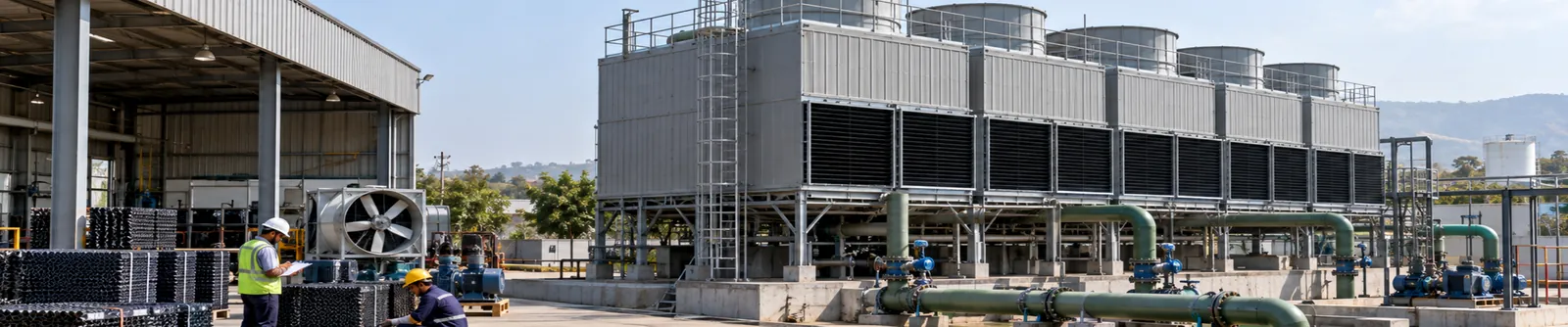
Why Choose an Induced-Draft Cooling Tower Manufacturers in Boisar
SP Cooling Towers Pvt. Ltd.A Induced-Draft Cooling Tower Manufacturers in Boisar that provides solutions based on individual cooling requirements, water flow, heat load, and operating conditions. Special attention is paid to the choice of an appropriate tower arrangement that can give effective and steady cooling.
With the airflow, water distribution, and heat transfer in mind, and the general tower design, SP Cooling Tower Pvt. Ltd. develops solutions tailored to meet different cooling needs in industries. Discuss with us what you will require so that we can find the right induced-draft cooling tower that will satisfy your requirements.
How Does an Induced Draft Cooling Tower Work?
Operating Process: The process starts when hot water from the industrial process is introduced into the cooling tower and into the distribution system. The spray nozzles or other distribution arrangements distribute the water over the field, and the greater the contact the water has with air, the better. Meanwhile, the fan pulls air into the tower via the air inlets and carries it upwards via the wet fill.
With contact between the air and the water, the warmer water heats the cooler air, and evaporation takes away more heat from the circulating water. The resultant cooled water is poured into the collection basin, pumped back into the process to be used again. Meanwhile, the hot and damp air moves on and flows out through the fan, and the cooling cycle is completed.
Induced Draft Cooling Tower Exporters in Boisar
SP Cooling Towers Pvt. Ltd. is one of the best Induced-Draft Cooling Tower Exporters in Boisar, and they provide the solution to the cooling towers used in industries with various cooling requirements and operating conditions.
The airflow management alongside water distribution will be beneficial in ensuring effective heat rejection and dependable cooling operation in different applications.
Main Components of an Induced Draft Cooling Tower
-
Fan: The fan will create the airflow required to introduce ambient air into the tower and remove hot and humid air.
-
Fill: Fill increases the area of contact between air and water, and there is an effective transfer of heat and moisture.
-
Water Distribution System: This system is used to distribute the circulating hot water evenly across the fill in order to make full use of the available cooling area.
-
Air Inlets: The air gets into the tower via these openings and is pulled towards the fill due to the induced draft by the fan.
-
Drift Eliminators: This is aimed at reducing the number of water droplets that are carried off with the exiting air and is used to reduce the amount of water loss and drift.
-
Cold-Water Basin: This basin receives the cooled water that has passed through the fill and offers a location where the water may be given back into the process.
-
Fan Stack: The stack is in charge of discharging the air upwards, and separating the exhaust to avoid the area of the tower air intake.
Leading Induced Draft Cooling Tower Suppliers in Boisar
SP Cooling Towers Pvt. Ltd. is an Induced-Draft Cooling Tower Suppliers in Boisar that provides solutions to unique industrial cooling needs, water circulation, heat load, and working conditions. The right tower design is appropriate to preserve good airflow and heat transfer, which is why it is applicable to the processes that need constant and constant water cooling.
Being an India-based company, SP Cooling Towers Pvt. Ltd. provides industrial cooling solutions depending on the needs of the industry within the framework of Boisar (Tarapur MIDC and Boisar industrial area) with consideration of the practical application needs and stable operation. Having been involved in the production and delivery of cooling towers, we are able to provide FRP cooling tower solutions to various industrial processes.
Applications of Induced Draft Cooling Towers
Applications of induced draft cooling towers are where the circulating water must be cooled and then moved back to an industrial or commercial process. Typical applications include:
-
Power generation plants
-
Chemical processing facilities
-
Petrochemical plants and refineries.
-
Processing of steel and metals.
-
Central cooling systems and HVAC.
-
Manufacturing plants
-
Food and beverage processing.
Appropriate tower design depends on the process, and this is why heat load, rate of water circulation, temperature of entering and leaving water, ambient wet-bulb temperature, and cooling range required should be taken into account when choosing a tower.
Advantages of Induced Draft Cooling Towers
Induced draft design has a number of practical advantages since the fan actively regulates the airflow in the tower. Its high air release can be used to minimize the exhaust-air recirculation, and the mechanical airflow enables the tower to sustain cooling performance during variable operating conditions.
It can also be scaled up to other capacities and industrial needs, rendering it applicable to both process cooling and large-scale water-cooling applications. Simultaneously, the choice of fans, fill condition, as well as water distribution, drift control, and routine maintenance will be crucial towards ensuring that the tower performs as it is expected.
Types of Induced Draft Cooling Towers
Depending on the arrangement of the air and water within the tower, one can set induced draft cooling towers in various ways. The two commonly used designs are counterflow and crossflow, and the distinction between the two designs is primarily in the direction the air flows in as compared to the direction the falling water flows.
-
Counterflow Design: Hot water flows downward, and air flows upward in the opposite direction to provide good heat transfer in a small tower configuration.
-
Crossflow Design: Water flows downwards, and air flows horizontally across it, making it easy to access the water distribution system and maintain it.
Key Factors for Selecting an Induced Draft Cooling Tower
The first step in choosing the right induced-draft cooling tower is to know how much heat to reject. The basic cooling capacity depends on the heat load, and the rate of circulation of the water depends on the flow rate of the circulating water.
The necessary hot-water temperature and cold-water temperature at that time are used to determine the cooling range, whereas the ambient wet-bulb temperature affects the lowest achievable practical temperature by evaporative cooling. These operating conditions should be viewed as a unit since altering one parameter could influence the necessary airflow, fill area, and fan capacity, as well as the overall tower size.
The space available to install is also a factor since the tower should have enough airflow and easy access for maintenance without imposing undue restrictions on the space. After these operating and location conditions are determined, the fan, fill, water distribution system, and drift eliminators (among other components) can be chosen to suit the duty required.
Induced Draft Cooling Tower Maintenance Checklist
The entire cooling cycle must be followed with a practical maintenance program starting with the water-distribution system to the fill, air path, fan, and basin. Periodic check-up should entail:
-
Fan/Motor: Check operation, vibration, alignment, and apparent wear.
-
Fill: Check scaling, fouling, physical damage, or blocked passages.
-
Nozzles: Nozzles should not be blocked; water should be evenly distributed.
-
Drift Eliminators: Examine the damage, displacement, and excessive deposits.
-
Basin: Clean up the debris in the basin and verify the condition of the basin.
-
Water Quality: Survey conditions that may lead to scaling, corrosion, and biological proliferation.
-
Air Inlets: Inlet points need to be open to ensure that the required air enters the tower.
-
Mechanical Components: Check bearings, shafts, drives, and other moving components based on the equipment requirements.
Since these parts are part of a single cooling system, regular check-ups are used to detect emerging issues before they substantially impact heat rejection or operating life.
Where Induced Draft Cooling Towers Fit Best
An induced-draft cooling tower is also most appropriate when the application has a need to control airflow mechanically and to reject process heat continuously. Its working principle enables the fan to draw air in the wet part and release warm, humid air over the tower, forming a specific airflow direction between the inlet and outlet.
The ultimate tower design must then be chosen based on the real process operation as opposed to mere cooling capacity. All these factors, heat load, water circulation, temperature requirements, ambient conditions, tower configuration, space availability, water quality, and maintenance requirements, should be considered as a unit to get an appropriate and sustainable cooling arrangement.
Why choose SP Cooling Towers Pvt. Ltd. for an induced-draft cooling tower?
Induced-draft cooling tower solutions are provided by SP Cooling Towers Pvt. Ltd., which are based on your unique cooling needs. The focus is on the proper airflow, good heat transfer and proper water distribution to maintain reliable tower operation.
The cooling tower will be capable of offering the required amount of performance to the required process cooling requirement, with the right arrangement to suit your application. Kindly provide details of your requirements with SP Cooling Towers Pvt. Ltd. in order to identify the suitable solution.
Get the Right Induced Draft Cooling Tower for Your Application
From SP Cooling Towers Pvt Ltd…. Now!