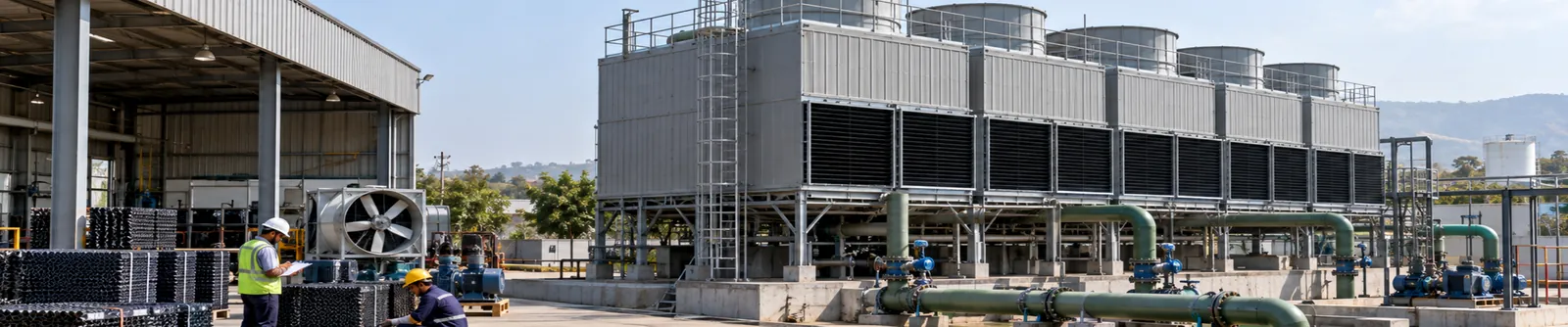
Choosing the right cooling tower starts with understanding that "cooling tower" isn't one product it's a category covering several distinct designs, each suited to a different combination of cooling load, footprint and site conditions. As manufacturers, suppliers and exporters of industrial cooling towers, we build across the full range, from compact FRP towers for tight sites to large timber and atmospheric towers for continuous industrial duty. Rather than offering a single fixed design, we help you identify the right category, sub-category and type before recommending a specific tower, so what you order actually matches your application.
So how many types of cooling tower are there, exactly? Cooling towers are generally grouped by construction material and by how air moves through the fill:
|
Type |
Category |
Construction Material |
Draft/Air Movement |
Typical Application |
|
Induced Draft Cooling Tower |
FRP sub-type |
Fibreglass (FRP) |
Fan at air outlet, pulls air through fill |
Industrial & commercial process cooling |
|
Forced Draft Cooling Tower |
FRP sub-type |
Fibreglass (FRP) |
Fan at air intake, pushes air through fill |
Compact installations, lower noise near intake |
|
Cross Flow Cooling Tower |
FRP sub-type |
Fibreglass (FRP) |
Fan-driven (induced/forced) |
Facilities needing easier maintenance access |
|
Counterflow Cooling Tower |
FRP sub-type |
Fibreglass (FRP) |
Fan-driven (induced/forced) |
High thermal efficiency applications |
|
Round Cooling Tower |
FRP sub-type |
Fibreglass (FRP) |
Single central fan |
Compact footprint, space-constrained sites |
|
Square Cooling Tower |
FRP sub-type |
Fibreglass (FRP) |
Modular multi-cell fans |
Scalable, high-capacity industrial demand |
|
Timber Cooling Tower |
Standalone type |
Treated timber |
Fan-driven (legacy design) |
Legacy and large-scale industrial installations |
|
Atmospheric Cooling Tower |
Standalone type |
Concrete/FRP (varies) |
Natural wind-driven, no fan |
Large-scale plants with high natural airflow needs |
Cooling towers are implemented in any place where industrial processes produce surplus heat, which must be effectively removed and in a continuous manner. Various categories and types are used in various sectors depending on the scale, load and site conditions:
The correct choice of cooling tower to use in each of these applications varies depending on heat load, available footprint, and site conditions, so selecting the appropriate category and type is more important than selecting one single, so-called, standard design.
Beyond the fan-driven FRP and timber designs above, a natural draft cooling tower — sometimes spelled natural draught cooling tower — works on a different principle entirely, using the natural buoyancy of warm, moist air rising through a tall hyperbolic structure rather than a mechanical fan. It's classed as a wet cooling tower, meaning heat is rejected primarily through evaporation as water and air come into direct contact — the same underlying principle used across most tower types in this range, just without fan-driven draft. This design, also referred to simply as a natural cooling tower, suits very large, continuous cooling loads such as power plants, where the tower's own height generates enough airflow to be effective.
In this design, hot water is distributed across a fill or splash system near the base of a tall, typically hyperbolic concrete shell.Since the evaporating water heats the surrounding air, this air is made less dense and naturally ascends through the structure pulling cooler ambient air in through the openings in the base to replace it, and this cooling convective cycle needs no fan. The following natural draft diagram of a cooling tower is a typical representation of this airflow path: cool air enters at the low point around the perimeter, rises through the fill and ascending water droplets, and escapes the tower as warm and humid air at the top of the shell, and cooled water is recirculated by a basin beneath.
With this many categories and types available, the right choice comes down to your specific heat load, available footprint, site wind conditions and budget — a compact round or square FRP tower suits most standard industrial and commercial needs, while natural draft or timber towers are typically reserved for very large, continuous-duty installations like power plants. Rather than guessing between designs, our team reviews your site conditions and recommends the category and type that actually fits, before you commit to a specification. Every cooling tower type solves a different combination of load, space and site conditions — the right one is the one matched to yours, not the biggest or most advanced. Talk to our team before you specify, and we'll help you get that match right the first time.
Share the flow rate, hot and cold water temperatures, and site wet-bulb for tower selection and a budgetary estimate.