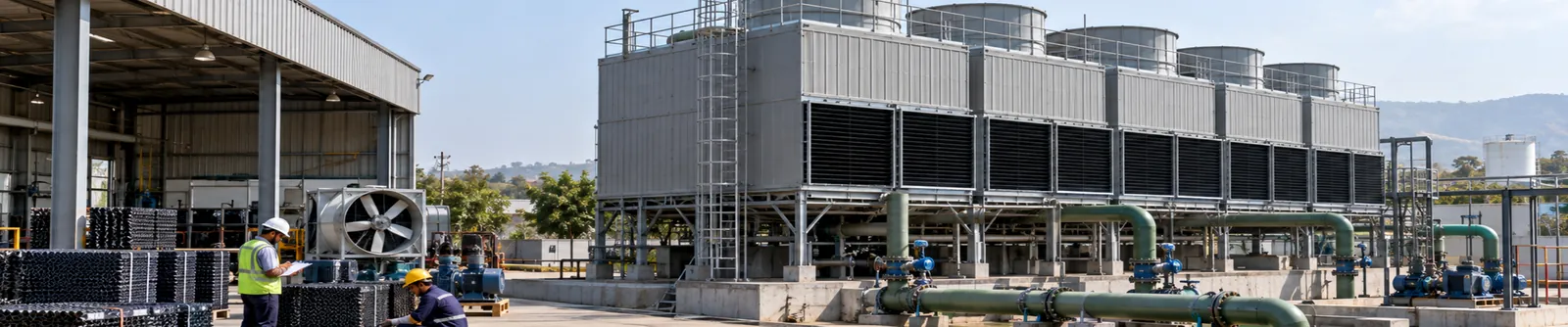
During operation, industrial equipment produces a lot of heat. Unless this heat is removed appropriately, it can impact equipment performance, efficiency and service life. The cooling tower offers a good solution to eliminate this surplus heat in circulating water and dissipate it into the air.
We are manufacturers, suppliers and exporters of cooling tower components and industrial cooling solutions, and we know that each component has its role to play in ensuring a reliable cooling performance. Cooling tower fills, nozzles, fans, motors, gearboxes, drift eliminators, and more all play a particular role in the cooling process. This paper describes the principle of the cooling tower, its major parts and how they can work with each other.
A cooling tower is a heat-rejection system used to cool hot circulating water by transferring its heat to the surrounding air.
The simple cooling process is:
Industrial Process → Hot Water → Cooling Tower → Cooled Water → Industrial Process.
Water takes up the heat of the equipment, like condensers, heat exchangers, compressors and other industrial machinery. This hot water goes into the cooling tower, and the heat in the water is exchanged with the air. The cooled water is then pumped back to the process.
To put it simply, the definition of a cooling tower is a system that takes heat out of circulating water, primarily by evaporative cooling.
Cooling tower equipment is primarily used to remove heat continuously out of water to allow it to be recycled and used again in the cooling process.
In the absence of a cooling tower, the amount of heat taken in by the circulating water would further rise and ultimately lower its capacity to absorb heat in industrial equipment.
Cooling towers benefit industries:
Now we will consider the principle of the cooling tower to know how this process of heat removal occurs.
The cooling tower working principle is mainly based on evaporation cooling.
Hot water is injected into the tower and scattered in a vast surface area with a water distribution system. Meanwhile, air is passed through the tower.
A little water evaporates when the hot water is exposed to the moving air. The water provides the heat needed to do the evaporation. This will cool the circulating water and reduce the temperature.
The simple procedure is:
Hot Water → Water Distribution → Air-Water Contact → Evaporation & Heat Transfer → Cooled Water
The chilled water is collected in the basin and pumped back to the industrial process. The cycle is then repeated. We will now discuss the working of the product in detail.
The movement of the water and air through the cooling tower simplifies the understanding of the cooling tower working process.
The water initially goes through industrial machinery and harnesses heat. The resultant hot water is pumped into the cooling tower.
Hot water is evenly spread over the fill material by cooling tower nozzles inside the tower.
Proper water distribution is relevant since it enhances the interaction of water and air and enables the tower to make the most of the cooling surface that it has.
The water that passes over the cooling tower fills.
The surface area and the contact time between water and air is increased by fills. Rather than letting the water fall into the basin, the fill diffuses the water into thin films or droplets and enhances heat and mass transfer.
The tower allows air to move through and collide with the water that falls.
Mechanical-draft cooling towers have a cooling tower fan that generates the airflow. A cooling tower pushes the fan using a cooling tower motor, with other mechanical parts aiding in the transmission and control of the necessary power.
The heat is then transferred to the air as the air and water interact with each other.
A small part of the water evaporates, which transports heat off of the circulating water. The rest of the water is cooled.
At the bottom of the tower, the cooled water is collected in the basin.
It is pumped back to the industrial equipment, where it again absorbs heat.
This forms a cycle of continuous cooling.
A cooling tower diagram or a cooling tower drawing can be simply represented as shown below:
Hot Water Inlet
↓
Cooling Tower Nozzles
↓
Cooling Tower Fills
↑
Air Flow from Cooling Tower Fan
↓
Cooled Water
↓
Collection Basin
↓
Pump
↓
Back to Industrial Process
The real cooling tower drawing can have more elements like the motor, fan blade, fan cylinder, gearbox, flow control valve, drift eliminator and SS grids.
A cooling tower operates based on a number of components. Knowing the role of each component also contributes to the entire cooling tower operation.
The fan system is powered by a cooling tower motor. It moves the fan and allows air to flow in the tower continuously.
The motor must be chosen appropriately based on the airflow required, fan size, working conditions and cooling tower capacity.
The cooling tower fan circulates air in the tower. Proper air circulation is necessary to carry out the heat and moisture to the atmosphere through the circulating water.
The fans are of special significance in mechanical-draft cooling towers.
The fan assembly that moves air in the tower is its cooling tower fan blade.
The design of the blades, size, and pitch, and the speed of operation may affect the airflow, energy consumption, and the overall cooling.
The air flowing around the fan assembly is surrounded or directed by a cooling tower fan cylinder. It assists in the direction of the air flow and ensures the right functioning of fans.
The cooling tower gear box helps to transfer the power to the fan and enable the fan to work at the right speed.
The gearbox is a significant mechanical part of the cooling tower in bigger cooling tower systems, and it should be lubricated, aligned, and inspected accordingly.
The cooling tower nozzle sprays water down over the fill material.
Regular spraying facilitates making sure that the fill area available is utilised well and that no parts of the tower receive either excess water or insufficient water.
Cooling tower fills create the surface area that is necessary to facilitate successful contact between air and water.
They are significant contributors to heat transfer since they prolong the time and space with which water is in contact with moving air.
A cooling tower flow control valve controls the flow of water in the cooling system.
Effective flow control is used to ensure the necessary water distribution and operating conditions by the requirements of the cooling tower design and process.
Depending on the design of the tower, cooling tower SS grids that typically comprise stainless steel can be utilised as structural or support components of the cooling tower system.
Stainless steel is corrosion-resistant, and it is applicable in water and industrial environments where it is needed.
A cooling tower drift eliminator decreases the quantity of water droplets that are removed with the exhaust air out of the tower.
This will reduce the loss of water and limit the release of circulating-water droplets into the surrounding environment.
Cooling towers can be classified according to their airflow arrangement and method of operation.
Natural-draft towers rely on the variations in air temperature and air density to produce airflow. Such towers are typically large and are usually found in large-scale power plants.
A mechanical-draft cooling tower is a cooling tower that circulates air in the tower through the use of fans; it is mostly applicable in industrial and commercial environments.
They are mostly categorised as:
Cooling towers can also be categorised as crossflow and counterflow in accordance with the direction of airflow.
Cooling towers are employed in those industries where it is necessary to continuously remove heat in circulating water.
Common applications include:
The fundamental cooling tower operation is the same no matter the use: eliminate heat to circulating water and discharge the cooled water back into the process.
A cooling tower is a significant heat-rejection system to cool down circulating water and discharge excessive heat to the atmosphere.
The cooling tower working principle is predominantly founded on evaporative cooling. The tower receives hot water, which is circulated by nozzles; it flows over the cooling tower and comes into contact with the moving air. Some of the heat is passed onto the air, and the rest of the water evaporates. The chilled water is then recaptured back to the industry.
This process involves several components that operate in coordination to achieve efficiency, such as the cooling tower motor, fan, fan blade, fan cylinder, gearbox, nozzles, fills, flow control valve, SS grids and drift eliminator.
Knowledge of what a cooling tower is, the functioning of its parts, and the flow of water and air through the system gives a clear-cut understanding of why cooling towers are popular in various industrial applications
Share the flow rate, hot and cold water temperatures, and site wet-bulb for tower selection and a budgetary estimate.