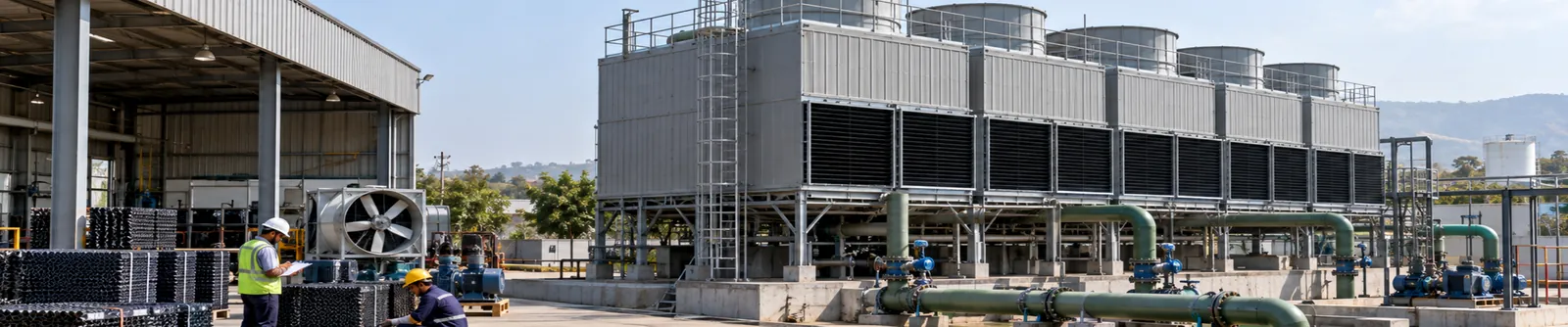
Industrial cooling tower costs typically range from a few lakhs for small FRP towers to several crores for large natural draft towers, depending on capacity, material, and draft type. Exact pricing varies by manufacturer, so it's best to get a custom quote based on your specific heat load and capacity requirements.
Regular checks should be performed during operation, with detailed maintenance at planned intervals. Inspect fills, nozzles, drift eliminators, gearboxes, motors, fans, and water-distribution systems for clogging, wear, leakage, or damage.
Poor performance can be a result of fouled or damaged fills, blocked nozzles, incorrect water distribution, fan problems, excessive scaling, or insufficient airflow or changes in the original operating conditions.
The choice of materials used in the construction of the structure — and often the internal parts as well — relates to the design of the cooling tower. Common materials include FRP, timber, RCC, stainless steel, galvanized steel, and PVC, all chosen for their resistance to corrosion.
Proper water distribution, clean fills and nozzles, well-maintained fans, adequate airflow for drift elimination, and periodic checks of critical components all help improve efficiency.
An FRP cooling tower is a new type of cooling tower developed using FRP (Fiber Reinforced Plastic) materials. It rejects heat from circulating water through evaporation and air-water contact and is widely used across industrial, HVAC, chemical, plastic, and electrical applications.
FRP cooling towers offer corrosion resistance, lightweight construction, and low maintenance. They are well suited to damp, demanding industrial conditions and constant water exposure and can be customized in design to match specific cooling capacity and installation requirements.
Air flows through the tower while hot circulating water is sprayed onto the fill. A portion of the water evaporates, carrying heat away from the remaining circulating water. The cooled water is then collected and returned to the industrial process for reuse.
Selection is based on heat load, water flow rate, inlet and outlet water temperature, and ambient conditions. We also factor in available space, water quality, operating hours, and maintenance needs. Together, these determine the right tower size, fill type, and fan selection.
Price depends on cooling capacity, water flow, heat load, and tower dimensions. Fan size, motor power, fill media, nozzles, drift eliminators, and FRP specifications also play a role. Customization, additional components, packaging, and shipping can further affect the final cost.
SP Cooling Towers Pvt Ltd concentrates on cooling tower solutions based on applications, custom requirements, timely supply, technical help, installation services, and maintenance needs.
This depends on various parameters like the cooling requirement, water flow rate, inlet temperature, outlet temperature, ambient conditions, area, airflow pattern, quality of water, and maintenance issues.
Timber cooling towers are ideal for use in large-scale industrial cooling systems. They provide a viable structural option that is tailored to the capacity, airflow pattern, and other requirements.
Water enters the cooling tower and passes through the fill. When the water contacts moving air, a small portion of it evaporates, hence cooling the rest of the water.
The cooling tower motor is the electric motor that drives the fan in the mechanical draft cooling tower. It supplies torque to generate air flow in the cooling tower.
The cooling tower fan motor is a motor which runs a cooling tower fan. The motor depends upon the size of the fan, power needs, speed, cooling tower capacity, etc.
For buying a cooling tower motor, the buyers have to provide information about the power of the motor, speed of the motor, voltages, type of mounting, model of cooling tower, specification of fan, etc.
The factors that affect the price of a cooling tower motor are power of the motor, speed of the motor, efficiency, construction, mounting, quantity, etc.
Yes. Consumers can buy a cooling tower fan motor to be replaced and maintained depending on the technical specifications of the motor and compatibility with the existing fan and drive.
Air flow is provided by the fan blades of the cooling tower that are used to remove the heat from the flowing water. Their shape has a direct impact on their airflow, efficiency of the fans and stable cooling tower operation.
Aluminium, FRP are used to make fan blades for cooling towers. The appropriate one will be based on application, temperature, size and design requirements of the fan.
Fan diameter, blade length, number of blades, pitch, operating RPM, material, and hub type and existing blade specifications are key points. These details will help minimise the chance of a bad substitute.
The Cooling Tower Fan Blade Price depends on the material, dimensions, fan diameter, blade profile, pitch, mounting arrangement, quantity, testing and transportation requirements. Other replacement and new installation requirements may also affect the cost.
The fan cylinder that circumscribes the fan discharge area assists to create controlled air flow when leaving the cooling tower. It also offers proper fan clearance and acts as an interface between the Fan system and Tower system.
The FRP fan cylinder has the characteristics of lightweight, moisture and corrosion resistance. They can also be produced in application-specific dimensions, which allows them to be used in a variety of industrial cooling applications.
The price varies with cylinder diameter and height, material, thickness, manufacturing process, quantity, mounting dimensions and custom dimensions. Packaging and shipping can also have an impact on the price.
Parameters of selection include size of fan, diameter of the cylinder, material, mounting method and working conditions. Use drawings, existing dimensions and application information to minimize dimensional mismatch.
A Stainless Steel Cooling Tower Grid is a fabricated or assembled structure aggregated from stainless steel sections, wires, bars or other shapes. Can be used to support, separate, protect or permit controlled movement of air and water, depending on the tower design.
Good resistance to moisture and corrosion, suitable for cooling tower environment, stainless steel is well resistant in the field of cooling tower. It also has mechanical strength and a surface that can be cleaned, which can be used to ensure reliable service and maintenance.
The term SS Grid 4×4 typically refers to a grid that opens or has a spacing of 4×4. However, the definition needs to be verified with reference to opening size, mesh pattern, or some other project-related measurement.
The buyer shall specify the grade of the stainless steel, opening size, panel size, thickness, load capacity, fixing details and quantity. The drawing, photo or sample can also be helpful for non-standard requirements.
The cooling tower grid is used in the process industries, chemical processing plants, power and utility plants, HVAC systems and industrial replacement projects. They are used for specific cooling tower arrangements and their exact function is dependent on that.
The cooling tower fan is geared down with a Cooling Tower Gear Box to increase torque, and pass rotational power from the motor to the fan. Helps fan to operate at the desired RPM for the correct airflow.
Buyers are to provide motor power and RPM, fan diameter and RPM, gear ratio, shaft sizes and existing gearbox information and mounting. Photographs and nameplate information can also be useful in determining compatibility.
The Cooling Tower Gear Box price is determined by the motor power, gear ratio, torque rating, shaft size, gear box housing structure, type and number of bearings, lubrication system, customization and order size.
Regular checks on oil condition, oil leakage, vibration, abnormal noise, bearing condition, shaft alignment, gear temperature and coupling and mounting bolts are recommended. Maintenance should be carried out in accordance with manufacturer's specifications and operating conditions.
A cooling tower drift eliminator is an element that is used to decrease the number of water droplets that are carried out of the tower with the exhaust air.
It reduces the water loss, and no water droplets are released to the environment, as well as the exhaust air.
Replacement is based on the condition, operating environment, water quality, and indications of damage, blockage, brittle nature, and poor performance.
Obvious damages, too much water carryover, deformation, scaling, clogging, or deteriorated material may be signs that the drift eliminator requires attention.
Drift eliminators come in various designs and configurations to accommodate the airflow, water flow, tower layout, and operational requirements.
The cooling towers need to be checked and serviced after a period depending on the condition of operation, quality of water, usage, and the maintenance requirements of the manufacturer.
Regular maintenance may involve checking and cleaning fill media, nozzles, drift eliminators, basins, fans, motors, gearboxes, and other available parts.
Regular maintenance is used to detect wear and tear, deposits, blockages, and other operational problems in the components before they impact the cooling tower's performance.
Some of the problems are scaling, fouling, clogged nozzles, damaged fill, worn drift eliminators, water distribution, corrosion, and wear of mechanical components.
When dirt, deposits, or wear have compromised the performance of components, proper maintenance may be used to restore airflow, water distribution, heat transfer conditions, and component operation.
The replacement of the components should be considered in case they are broken, worn out, deteriorated, clogged, or no longer able to serve the purpose they are supposed to serve.
It is true that in many cases, individual parts can be substituted, provided that the current tower structure and configuration can be substituted with appropriate replacement parts.
Cooling tower retrofit is the upgrading or replacement of specific cooling tower components in response to a performance, condition, compatibility, or operational need.
Replacement or retrofit work can be done on fill media, drift eliminators, nozzles, fans, motors, gearboxes, water distribution parts, and other components depending on the design of the tower.
The choice will be determined by the state of the tower that is currently in use, the damage to parts, the performance concerns, the compatibility of the new parts, and the level of upgrading that is required.
SP Cooling Towers Pvt Ltd makes PVC fills, drift eliminators, spray nozzles, header pipes, fans, gear boxes, shafts, bearings, couplings, louvers, and many other cooling tower components and accessories.
Yes. Replacement cooling tower spare parts can be provided.
Yes. Industrial cooling tower spare parts are supplied by us, which are used in power plants, steel plants, cement plants, chemical industries, manufacturing plants, etc.
Yes, they can be customized as per the specifications of the cooling tower.
Components used in cooling towers can be used in FRP cooling towers, wood cooling towers, cross-flow cooling towers, counter-flow cooling towers, and many others.
Select a nozzle depending on the flow rate and spray pattern required, operating pressure, material compatibility, connection possibilities, water quality, fill system, and the current water distribution system of the cooling tower.
Check the nozzle to ensure that it is not blocked, worn or damaged and verify its size and connection information. Photographs and/or existing specifications, flow requirements, and operating conditions can assist in determining a changeable nozzle.
Cooling tower nozzles are typically constructed of engineering plastics, PP-based materials, ABS-type plastics, stainless steel and other corrosion-resistant materials. The choice of materials is determined by the water chemistry, temperature, mechanical needs and the environment in which it is operated.
The prices of the cooling tower nozzle will be based on various factors, some of which comprise the material used, design, size, flow capacity, connection type, quantity, customization, packaging, location of order and the replacement or new installation needs.
SP Cooling Towers Pvt Ltd. assists customers to link up with appropriate Indian manufacturers and suppliers according to nozzle specifications, application needs, quantities, replacement demands, connection specifications, and other technical or procurement needs.
Prior to ordering replacement fills, review the current pack size, profile of the sheet, support system, direction of airflow, water flow system, operating temperature, necessary quantity and the supporting structure condition.
Proper water treatment, periodic inspection, removal of debris and appropriate choice of fill geometry can help decrease fouling by the water quality. Maintenance is also assisted by monitoring biological growth, suspended solids, scale and pressure drop.
PVC fill media enhance the contact surface between the flowing water and moving air by forming thin water films or droplets. This enhances evaporation and heat transfer whereby the cooling tower will be able to remove more heat.
The choice of PVC fill will be determined by the tower structure, water temperature, water quality, airflow layout, suspended solids, risk of biological fouling, sheet geometry, profile, thickness, maintenance needs, and anticipated operating conditions.
SP Cooling Towers Pvt Ltd. assists buyers to obtain PVC cooling tower fills with appropriate Indian manufacturers depending upon tower dimensions, fill requirements, operating conditions, replacement needs, project quantities, and on either domestic or foreign sourcing requirements.
A valve of the wrong size can limit the necessary amount of water flow, cause unnecessary pressure loss or offer inadequate control. A check of flow requirements, pressure conditions, pipe arrangement and the proposed function of valves avoids inappropriate selection.
Compare the existing valve connection information, dimensions, pressure rating, material, operating temperature, flow requirements and actuation method. Before choosing a replacement, the installation location and the work of the valve should also be verified.
Flow control and isolation valves are used to regulate or adjust the flow of water using a circuit and to prevent contact with equipment or other sections by isolating them. Certain installations might need both functions of the cooling system.
Valve actuation is a factor that defines the operation of the valve. Manual actuation is used when the system needs to be adjusted occasionally, whereas automated actuation may be used to provide frequent or continuous control with a control system that depends upon the operating conditions.
Yes, SP Cooling Towers Pvt Ltd. has the capability to arrange specification-based sourcing with Indian manufacturers for project and replacement needs and in light of valve arrangement, operating specifications, volume, connection, use, and the delivery venue necessary.
Check blade condition, fan balance, hub alignment, shaft alignment, fasteners, drive components, and bearings. Too much vibration is not necessarily a sign of a broken fan and therefore the entire mechanical unit must be examined prior to the replacement.
There can be replacement when the blades exhibit cracks, deformation, extreme deterioration, ensured imbalance or inappropriate performance. Check the alignment, drive components, operating conditions and other factors that may lead to problems before replacing the fan.
Here, the fan diameter is used to determine the area that is swept and affects the amount of air that can be moved by the fan. Nevertheless, diameter should be looked at in conjunction with blade geometry, rotational speed, pitch, motor qualities, and tower resistance to operate it in a way it suits.
Fan balancing can be used to ensure a smoother rotation and can lower undesired vibration and mechanical loading. The proper location and alignment of the hubs and either static balancing or dynamic balancing promote steady functioning of the fan assembly.
SP Cooling Towers Pvt Ltd. helps in source of the FRP fans, aluminum fans, replacement blades and whole fan assembly of the Indian manufacturing resources depending on the tower requirements, dimensions, quantities, application conditions, and project specifications.
FRP (Fibre Reinforced Plastic) offers excellent moisture and corrosion resistance, making it well-suited for the wet, humid conditions inside a cooling tower. It is also lightweight, which makes transportation, installation, and erection considerably easier compared to towers built with heavier materials.
The fan is mounted at the air inlet of the tower. It draws in and compresses air, forcing it into contact with the falling water so that heat transfer can take place efficiently.
Regular inspection and maintenance of the fan, motor, fill media, nozzles, and water distribution system/basin is essential. Water treatment should also be monitored closely to prevent microbial growth, corrosion, fouling, and scaling—all of which can significantly reduce cooling efficiency over time.
Yes. Towers can be customized based on parameters such as water flow rate, process heat load, operating and ambient temperatures, available space, required fan capacity, and other site-specific process requirements.
Cross flow towers are supplied from 10 TR to 1000+ TR per cell, available in single or multi-cell configurations depending on your total cooling load.
Yes. Alongside standard stocked capacities, towers can be engineered to a custom flow rate, approach temperature or footprint to match your specific site constraints.
Yes. Cooling range and approach temperature are guaranteed in writing against your specified design conditions, verified through thermal design checks before dispatch.
Usually fill media scaling or fouling, blocked water distribution nozzles, or a mismatch between actual water/air flow rates and the original design.
Counterflow towers are supplied from 20 TR to 1000+ TR per cell, available in single or multi-cell configurations depending on your total cooling load.
Mainly footprint and thermal efficiency — a counterflow tower achieves a given cooling range in a smaller site area, making it suited to locations where space is limited but pumping capacity is available.
Yes. Alongside standard stocked capacities, towers can be engineered to a custom flow rate, approach temperature or footprint to match your specific site constraints.
Usually a blocked or worn spray nozzle disrupting water distribution, fill media scaling or fouling, or spray system pressure falling outside the design range.
Yes. We supply the Gulf, Southeast Asia, Africa and other export markets, with every tower dismantled, packed for safe transit, and backed by material test certificates and commissioning support.
A round tower has a single central fan which draws air radially on all sides through the fill to create a small circular footprint and even distribution of air across the tower - as opposed to the vertical path of air and larger rectangular footprint of a counterflow tower.
The supply of round cooling towers is provided between 5 TR and 500 TR and in the single-cell supply.
Primarily footprint — the circular shape puts a greater heat transfer into a smaller area of the floor or roof, and it balances structural and wind loads across the base, and is appropriate in locations with little or an uneven area, such as rooftop installations.
Blocked or misaligned spray nozzle that interferes with spraying fill is typically the cause of uneven cooling; and an excess of water loss typically indicates the presence of damaged drift eliminators or fill scaling that redirects water flow.
Yes. Towers are available engineered to your specific flow rate and available footprint of installation in addition to regular inventory stocks.
Multi-cell design is modular, so you can add cells as the load increases, instead of having to replace the entire system, and the cells can be maintained independently, without having to shut down the whole tower.
Sizing is based on your actual heat load, water flow rate, design wet bulb temperature and required approach temperature — not just total tonnage — with cell configuration chosen to suit your footprint and any planned future expansion.
Sizing is based on your actual heat load, water flow rate, design wet bulb temperature and required approach temperature — not just total tonnage — with cell configuration chosen to suit your footprint and any planned future expansion.
Yes, that's the advantage of modular design. Sizing in spare cell positions upfront makes future expansion far cheaper than retrofitting capacity into a fixed single-cell tower later.
Yes. Each cell has its own isolation valves, so individual cells can be taken offline for maintenance while the remaining cells continue operating.
Maintenance discipline matters more than initial build quality — regular water treatment, fill inspection, structural corrosion checks and fan/drive servicing all directly extend service life.
An FRP induced-draft cooling tower is corrosion-resistant, lightweight, features low airflow, and offers efficient heat rejection. It can be adopted in continuous cooling systems in industry.
Hot water is circulated through the fill media, while ambient air is drawn up through the tower using a fan. The water transfers its heat to the air, and the cooled water is then stored in the basin.
Pricing is determined by a combination of factors, including cooling capacity, water flow rate, heat load, operating temperature, fan/motor size, fill media, FRP specifications, and customization requirements.
They find application in plastic processing, chemical, textile, power, metal, engineering, pharmaceutical, food, and HVAC industries. They can be employed in any location that calls for a continuous heat-rejection system.
Selection depends on water flow rate, inlet water temperature, outlet water temperature, wet-bulb temperature, water quality, and space requirements for installation. Other factors to consider when selecting the fan, motor, fill media, and water distribution components include the desired cooling load.
Yes, that's the advantage of modular design. Sizing in spare cell positions upfront makes future expansion far cheaper than retrofitting capacity into a fixed single-cell tower later.
Industrial cooling tower costs typically range from a few lakhs for small FRP towers to several crores for large natural draft towers, depending on capacity, material, and draft type. Exact pricing varies by manufacturer, so it's best to get a custom quote based on your specific heat load and capacity requirements.
Regular checks should be performed during operation, with detailed maintenance at planned intervals. Inspect fills, nozzles, drift eliminators, gearboxes, motors, fans, and water-distribution systems for clogging, wear, leakage, or damage.
Poor performance can be a result of fouled or damaged fills, blocked nozzles, incorrect water distribution, fan problems, excessive scaling, or insufficient airflow or changes in the original operating conditions.
The choice of materials used in the construction of the structure — and often the internal parts as well — relates to the design of the cooling tower. Common materials include FRP, timber, RCC, stainless steel, galvanized steel, and PVC, all chosen for their resistance to corrosion.
Proper water distribution, clean fills and nozzles, well-maintained fans, adequate airflow for drift elimination, and periodic checks of critical components all help improve efficiency.
An FRP cooling tower is a new type of cooling tower developed using FRP (Fiber Reinforced Plastic) materials. It rejects heat from circulating water through evaporation and air-water contact and is widely used across industrial, HVAC, chemical, plastic, and electrical applications.
FRP cooling towers offer corrosion resistance, lightweight construction, and low maintenance. They are well suited to damp, demanding industrial conditions and constant water exposure and can be customized in design to match specific cooling capacity and installation requirements.
Air flows through the tower while hot circulating water is sprayed onto the fill. A portion of the water evaporates, carrying heat away from the remaining circulating water. The cooled water is then collected and returned to the industrial process for reuse.
Selection is based on heat load, water flow rate, inlet and outlet water temperature, and ambient conditions. We also factor in available space, water quality, operating hours, and maintenance needs. Together, these determine the right tower size, fill type, and fan selection.
Price depends on cooling capacity, water flow, heat load, and tower dimensions. Fan size, motor power, fill media, nozzles, drift eliminators, and FRP specifications also play a role. Customization, additional components, packaging, and shipping can further affect the final cost.
The cooling tower motor is the electric motor that drives the fan in the mechanical draft cooling tower. It supplies torque to generate air flow in the cooling tower.
The cooling tower fan motor is a motor which runs a cooling tower fan. The motor depends upon the size of the fan, power needs, speed, cooling tower capacity, etc.
For buying a cooling tower motor, the buyers have to provide information about the power of the motor, speed of the motor, voltages, type of mounting, model of cooling tower, specification of fan, etc.
The factors that affect the price of a cooling tower motor are power of the motor, speed of the motor, efficiency, construction, mounting, quantity, etc.
Yes. Consumers can buy a cooling tower fan motor to be replaced and maintained depending on the technical specifications of the motor and compatibility with the existing fan and drive.
An FRP induced-draft cooling tower is corrosion-resistant, lightweight, features low airflow, and offers efficient heat rejection. It can be adopted in continuous cooling systems in industry.
Hot water is circulated through the fill media, while ambient air is drawn up through the tower using a fan. The water transfers its heat to the air, and the cooled water is then stored in the basin.
Pricing is determined by a combination of factors, including cooling capacity, water flow rate, heat load, operating temperature, fan/motor size, fill media, FRP specifications, and customization requirements.
They find application in plastic processing, chemical, textile, power, metal, engineering, pharmaceutical, food, and HVAC industries. They can be employed in any location that calls for a continuous heat-rejection system.
Selection depends on water flow rate, inlet water temperature, outlet water temperature, wet-bulb temperature, water quality, and space requirements for installation. Other factors to consider when selecting the fan, motor, fill media, and water distribution components include the desired cooling load.
SP Cooling Towers Pvt Ltd makes PVC fills, drift eliminators, spray nozzles, header pipes, fans, gear boxes, shafts, bearings, couplings, louvers, and many other cooling tower components and accessories.
Yes. Replacement cooling tower spare parts can be provided.
Yes. Industrial cooling tower spare parts are supplied by us, which are used in power plants, steel plants, cement plants, chemical industries, manufacturing plants, etc.
Yes, they can be customized as per the specifications of the cooling tower.
Components used in cooling towers can be used in FRP cooling towers, wood cooling towers, cross-flow cooling towers, counter-flow cooling towers, and many others.
SP Cooling Towers Pvt Ltd concentrates on cooling tower solutions based on applications, custom requirements, timely supply, technical help, installation services, and maintenance needs.
This depends on various parameters like the cooling requirement, water flow rate, inlet temperature, outlet temperature, ambient conditions, area, airflow pattern, quality of water, and maintenance issues.
Timber cooling towers are ideal for use in large-scale industrial cooling systems. They provide a viable structural option that is tailored to the capacity, airflow pattern, and other requirements.
Water enters the cooling tower and passes through the fill. When the water contacts moving air, a small portion of it evaporates, hence cooling the rest of the water.
Select a nozzle depending on the flow rate and spray pattern required, operating pressure, material compatibility, connection possibilities, water quality, fill system, and the current water distribution system of the cooling tower.
Check the nozzle to ensure that it is not blocked, worn or damaged and verify its size and connection information. Photographs and/or existing specifications, flow requirements, and operating conditions can assist in determining a changeable nozzle.
Cooling tower nozzles are typically constructed of engineering plastics, PP-based materials, ABS-type plastics, stainless steel and other corrosion-resistant materials. The choice of materials is determined by the water chemistry, temperature, mechanical needs and the environment in which it is operated.
The prices of the cooling tower nozzle will be based on various factors, some of which comprise the material used, design, size, flow capacity, connection type, quantity, customization, packaging, location of order and the replacement or new installation needs.
SP Cooling Towers Pvt Ltd. assists customers to link up with appropriate Indian manufacturers and suppliers according to nozzle specifications, application needs, quantities, replacement demands, connection specifications, and other technical or procurement needs.
FRP (Fibre Reinforced Plastic) offers excellent moisture and corrosion resistance, making it well-suited for the wet, humid conditions inside a cooling tower. It is also lightweight, which makes transportation, installation, and erection considerably easier compared to towers built with heavier materials.
The fan is mounted at the air inlet of the tower. It draws in and compresses air, forcing it into contact with the falling water so that heat transfer can take place efficiently.
Regular inspection and maintenance of the fan, motor, fill media, nozzles, and water distribution system/basin is essential. Water treatment should also be monitored closely to prevent microbial growth, corrosion, fouling, and scaling—all of which can significantly reduce cooling efficiency over time.
Yes. Towers can be customized based on parameters such as water flow rate, process heat load, operating and ambient temperatures, available space, required fan capacity, and other site-specific process requirements.
The cooling towers need to be checked and serviced after a period depending on the condition of operation, quality of water, usage, and the maintenance requirements of the manufacturer.
Regular maintenance may involve checking and cleaning fill media, nozzles, drift eliminators, basins, fans, motors, gearboxes, and other available parts.
Regular maintenance is used to detect wear and tear, deposits, blockages, and other operational problems in the components before they impact the cooling tower's performance.
Some of the problems are scaling, fouling, clogged nozzles, damaged fill, worn drift eliminators, water distribution, corrosion, and wear of mechanical components.
When dirt, deposits, or wear have compromised the performance of components, proper maintenance may be used to restore airflow, water distribution, heat transfer conditions, and component operation.
Prior to ordering replacement fills, review the current pack size, profile of the sheet, support system, direction of airflow, water flow system, operating temperature, necessary quantity and the supporting structure condition.
Proper water treatment, periodic inspection, removal of debris and appropriate choice of fill geometry can help decrease fouling by the water quality. Maintenance is also assisted by monitoring biological growth, suspended solids, scale and pressure drop.
PVC fill media enhance the contact surface between the flowing water and moving air by forming thin water films or droplets. This enhances evaporation and heat transfer whereby the cooling tower will be able to remove more heat.
The choice of PVC fill will be determined by the tower structure, water temperature, water quality, airflow layout, suspended solids, risk of biological fouling, sheet geometry, profile, thickness, maintenance needs, and anticipated operating conditions.
SP Cooling Towers Pvt Ltd. assists buyers to obtain PVC cooling tower fills with appropriate Indian manufacturers depending upon tower dimensions, fill requirements, operating conditions, replacement needs, project quantities, and on either domestic or foreign sourcing requirements.
Cross flow towers are supplied from 10 TR to 1000+ TR per cell, available in single or multi-cell configurations depending on your total cooling load.
Yes. Alongside standard stocked capacities, towers can be engineered to a custom flow rate, approach temperature or footprint to match your specific site constraints.
Yes. Cooling range and approach temperature are guaranteed in writing against your specified design conditions, verified through thermal design checks before dispatch.
Usually fill media scaling or fouling, blocked water distribution nozzles, or a mismatch between actual water/air flow rates and the original design.
The replacement of the components should be considered in case they are broken, worn out, deteriorated, clogged, or no longer able to serve the purpose they are supposed to serve.
It is true that in many cases, individual parts can be substituted, provided that the current tower structure and configuration can be substituted with appropriate replacement parts.
Cooling tower retrofit is the upgrading or replacement of specific cooling tower components in response to a performance, condition, compatibility, or operational need.
Replacement or retrofit work can be done on fill media, drift eliminators, nozzles, fans, motors, gearboxes, water distribution parts, and other components depending on the design of the tower.
The choice will be determined by the state of the tower that is currently in use, the damage to parts, the performance concerns, the compatibility of the new parts, and the level of upgrading that is required.
A valve of the wrong size can limit the necessary amount of water flow, cause unnecessary pressure loss or offer inadequate control. A check of flow requirements, pressure conditions, pipe arrangement and the proposed function of valves avoids inappropriate selection.
Compare the existing valve connection information, dimensions, pressure rating, material, operating temperature, flow requirements and actuation method. Before choosing a replacement, the installation location and the work of the valve should also be verified.
Flow control and isolation valves are used to regulate or adjust the flow of water using a circuit and to prevent contact with equipment or other sections by isolating them. Certain installations might need both functions of the cooling system.
Valve actuation is a factor that defines the operation of the valve. Manual actuation is used when the system needs to be adjusted occasionally, whereas automated actuation may be used to provide frequent or continuous control with a control system that depends upon the operating conditions.
Yes, SP Cooling Towers Pvt Ltd. has the capability to arrange specification-based sourcing with Indian manufacturers for project and replacement needs and in light of valve arrangement, operating specifications, volume, connection, use, and the delivery venue necessary.
Counterflow towers are supplied from 20 TR to 1000+ TR per cell, available in single or multi-cell configurations depending on your total cooling load.
Mainly footprint and thermal efficiency — a counterflow tower achieves a given cooling range in a smaller site area, making it suited to locations where space is limited but pumping capacity is available.
Yes. Alongside standard stocked capacities, towers can be engineered to a custom flow rate, approach temperature or footprint to match your specific site constraints.
Usually a blocked or worn spray nozzle disrupting water distribution, fill media scaling or fouling, or spray system pressure falling outside the design range.
Yes. We supply the Gulf, Southeast Asia, Africa and other export markets, with every tower dismantled, packed for safe transit, and backed by material test certificates and commissioning support.
Check blade condition, fan balance, hub alignment, shaft alignment, fasteners, drive components, and bearings. Too much vibration is not necessarily a sign of a broken fan and therefore the entire mechanical unit must be examined prior to the replacement.
There can be replacement when the blades exhibit cracks, deformation, extreme deterioration, ensured imbalance or inappropriate performance. Check the alignment, drive components, operating conditions and other factors that may lead to problems before replacing the fan.
Here, the fan diameter is used to determine the area that is swept and affects the amount of air that can be moved by the fan. Nevertheless, diameter should be looked at in conjunction with blade geometry, rotational speed, pitch, motor qualities, and tower resistance to operate it in a way it suits.
Fan balancing can be used to ensure a smoother rotation and can lower undesired vibration and mechanical loading. The proper location and alignment of the hubs and either static balancing or dynamic balancing promote steady functioning of the fan assembly.
SP Cooling Towers Pvt Ltd. helps in source of the FRP fans, aluminum fans, replacement blades and whole fan assembly of the Indian manufacturing resources depending on the tower requirements, dimensions, quantities, application conditions, and project specifications.
A round tower has a single central fan which draws air radially on all sides through the fill to create a small circular footprint and even distribution of air across the tower - as opposed to the vertical path of air and larger rectangular footprint of a counterflow tower.
The supply of round cooling towers is provided between 5 TR and 500 TR and in the single-cell supply.
Primarily footprint — the circular shape puts a greater heat transfer into a smaller area of the floor or roof, and it balances structural and wind loads across the base, and is appropriate in locations with little or an uneven area, such as rooftop installations.
Blocked or misaligned spray nozzle that interferes with spraying fill is typically the cause of uneven cooling; and an excess of water loss typically indicates the presence of damaged drift eliminators or fill scaling that redirects water flow.
Yes. Towers are available engineered to your specific flow rate and available footprint of installation in addition to regular inventory stocks.
Air flow is provided by the fan blades of the cooling tower that are used to remove the heat from the flowing water. Their shape has a direct impact on their airflow, efficiency of the fans and stable cooling tower operation.
Aluminium, FRP are used to make fan blades for cooling towers. The appropriate one will be based on application, temperature, size and design requirements of the fan.
Fan diameter, blade length, number of blades, pitch, operating RPM, material, and hub type and existing blade specifications are key points. These details will help minimise the chance of a bad substitute.
The Cooling Tower Fan Blade Price depends on the material, dimensions, fan diameter, blade profile, pitch, mounting arrangement, quantity, testing and transportation requirements. Other replacement and new installation requirements may also affect the cost.
Multi-cell design is modular, so you can add cells as the load increases, instead of having to replace the entire system, and the cells can be maintained independently, without having to shut down the whole tower.
Sizing is based on your actual heat load, water flow rate, design wet bulb temperature and required approach temperature — not just total tonnage — with cell configuration chosen to suit your footprint and any planned future expansion.
Sizing is based on your actual heat load, water flow rate, design wet bulb temperature and required approach temperature — not just total tonnage — with cell configuration chosen to suit your footprint and any planned future expansion.
Yes, that's the advantage of modular design. Sizing in spare cell positions upfront makes future expansion far cheaper than retrofitting capacity into a fixed single-cell tower later.
Yes. Each cell has its own isolation valves, so individual cells can be taken offline for maintenance while the remaining cells continue operating.
Maintenance discipline matters more than initial build quality — regular water treatment, fill inspection, structural corrosion checks and fan/drive servicing all directly extend service life.
Yes, that's the advantage of modular design. Sizing in spare cell positions upfront makes future expansion far cheaper than retrofitting capacity into a fixed single-cell tower later.
The fan cylinder that circumscribes the fan discharge area assists to create controlled air flow when leaving the cooling tower. It also offers proper fan clearance and acts as an interface between the Fan system and Tower system.
The FRP fan cylinder has the characteristics of lightweight, moisture and corrosion resistance. They can also be produced in application-specific dimensions, which allows them to be used in a variety of industrial cooling applications.
The price varies with cylinder diameter and height, material, thickness, manufacturing process, quantity, mounting dimensions and custom dimensions. Packaging and shipping can also have an impact on the price.
Parameters of selection include size of fan, diameter of the cylinder, material, mounting method and working conditions. Use drawings, existing dimensions and application information to minimize dimensional mismatch.
A Stainless Steel Cooling Tower Grid is a fabricated or assembled structure aggregated from stainless steel sections, wires, bars or other shapes. Can be used to support, separate, protect or permit controlled movement of air and water, depending on the tower design.
Good resistance to moisture and corrosion, suitable for cooling tower environment, stainless steel is well resistant in the field of cooling tower. It also has mechanical strength and a surface that can be cleaned, which can be used to ensure reliable service and maintenance.
The term SS Grid 4×4 typically refers to a grid that opens or has a spacing of 4×4. However, the definition needs to be verified with reference to opening size, mesh pattern, or some other project-related measurement.
The buyer shall specify the grade of the stainless steel, opening size, panel size, thickness, load capacity, fixing details and quantity. The drawing, photo or sample can also be helpful for non-standard requirements.
The cooling tower grid is used in the process industries, chemical processing plants, power and utility plants, HVAC systems and industrial replacement projects. They are used for specific cooling tower arrangements and their exact function is dependent on that.
The cooling tower fan is geared down with a Cooling Tower Gear Box to increase torque, and pass rotational power from the motor to the fan. Helps fan to operate at the desired RPM for the correct airflow.
Buyers are to provide motor power and RPM, fan diameter and RPM, gear ratio, shaft sizes and existing gearbox information and mounting. Photographs and nameplate information can also be useful in determining compatibility.
The Cooling Tower Gear Box price is determined by the motor power, gear ratio, torque rating, shaft size, gear box housing structure, type and number of bearings, lubrication system, customization and order size.
Regular checks on oil condition, oil leakage, vibration, abnormal noise, bearing condition, shaft alignment, gear temperature and coupling and mounting bolts are recommended. Maintenance should be carried out in accordance with manufacturer's specifications and operating conditions.
A cooling tower drift eliminator is an element that is used to decrease the number of water droplets that are carried out of the tower with the exhaust air.
It reduces the water loss, and no water droplets are released to the environment, as well as the exhaust air.
Replacement is based on the condition, operating environment, water quality, and indications of damage, blockage, brittle nature, and poor performance.
Obvious damages, too much water carryover, deformation, scaling, clogging, or deteriorated material may be signs that the drift eliminator requires attention.
Drift eliminators come in various designs and configurations to accommodate the airflow, water flow, tower layout, and operational requirements.
Share the flow rate, hot and cold water temperatures, and site wet-bulb for tower selection and a budgetary estimate.