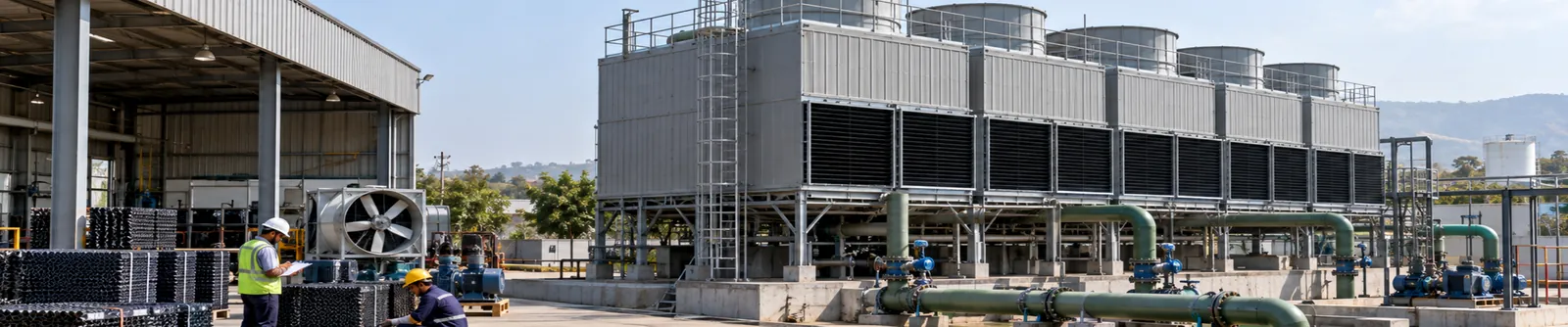
Calculation of the capacity of a cooling tower can be said to be one of the most vital engineering steps in selection and operation of an industrial cooling tower. Having the right cooling tower capacity means that the extra heat produced in the industries will be removed efficiently. This allows for proper working of equipment and cooling water systems. Not only does an ideal size increase cooling capacity, but it also cuts down the energy consumption, water losses and extends the equipment lifespan.
There are industries like the electricity power industry, chemical processing plants, pharmaceuticals, steel plants, food processing industries, textile plants, plastics, and HVAC systems which need the cooling towers to continuously reject heat from the circulating water. All industrial applications have varied cooling needs; thus, calculation of cooling towers is vital before choosing the appropriate cooling towers.
Selecting the incorrect capacity of the cooling tower can cause various challenges. If the capacity of the cooling tower is not sufficient, then it will not be able to cool down the water up to the required temperature and this will lead to overheating, decreased efficiency of the industrial process, and increased maintenance costs. Whereas in the case of the larger size of cooling tower it will increase the installation costs, electricity costs, and water treatment costs but will not provide any additional benefits. That is why it is essential to learn how to calculate the capacity of the cooling tower.
SP Cooling Towers Pvt Ltd. deals with the designing and manufacturing of the industrial cooling towers which are made according to the specific process heat load and conditions. We help the industries to calculate the appropriate capacity of the cooling tower, taking into consideration such factors as water circulation, heat load, temperature range, approach, and design of cooling tower.
Cooling tower capacity is the heat rejected from the circulating water in a cooling tower over a specific time period, and this takes place at certain working conditions. Simply put, the cooling capacity is the measure of the cooling capacity or the heat rejection capacity of the cooling tower. Cooling tower capacity is denoted in TR, kW or kcal/hr, depending on the industrial standards or project requirements.
In a cooling tower, heat rejection is done through the use of evaporation. The hot water is fed into the cooling tower, where it is passed over the fill material, and air runs through it. Some of the water evaporates, and with it, the heat is rejected, and as a result, the temperature of the water is lowered. The cooled water is fed back into the process.
The cooling tower capacity required is based on many essential factors, which include:
Selection of the right capacity of a cooling tower can help industries keep temperatures steady, improve efficiency, save power, and prevent any equipment damage.
Proper selection of the capacity of a cooling tower provides many advantages for industries, including:
Since each industry requires unique cooling capacity calculations, it is one of the significant aspects of cooling system design.
Before performing cooling tower calculations, collect the following process details:
|
Parameter |
Purpose |
|
Water Flow Rate (LPM or m³/hr) |
Total circulating water quantity. |
|
Hot Water Temperature |
Water entering the cooling tower. |
|
Cold Water Temperature |
Water leaving the cooling tower. |
|
Wet Bulb Temperature |
Ambient temperature used for cooling tower design. |
|
Range |
Difference between hot and cold water temperatures. |
|
Approach |
Difference between cold water temperature and wet bulb temperature. |
These values are essential for selecting the correct cooling tower capacity.
In case you are wondering about how to calculate cooling tower capacity, you can try this quick approach used in the industry.
Range = Hot Water Temperature – Cold Water Temperature
For example:
Hot Water = 42°C
Cold Water = 32°C
Range = 42 – 32 = 10°C
The range is the total amount of heat that the cooling tower will take away from the circulating water.
Heat Load Formula
Q = 4.186 × Flow Rate (LPS) × Range
Where:
Q = Heat Load (kW)
Flow Rate = Litres per Second
Range = Temperature Difference (°C)
Example Calculation
Input Value
Result
Water Flow Rate
100 LPS
Range
10°C
Heat Load
4186 kW
In order to determine cooling tower capacity in TR:
1\,TR=3.517\,kW1TR=3.517kW
Cooling Tower Capacity=Heat Load3.517Cooling\ Tower\ Capacity = \frac{Heat\ Load}{3.517}Cooling Tower Capacity=3.517Heat Load
As shown in the above example:
Capacity=4186
|
Parameter |
Value |
|
Hot Water Temperature |
40°C |
|
Cold Water Temperature |
30°C |
|
Wet Bulb Temperature |
26°C |
|
Water Flow Rate |
360 m³/hr |
|
Range |
10°C |
|
Approach |
4°C |
|
Estimated Cooling Tower Capacity |
Approx. 300 TR |
This is a standard cooling tower capacity calculation used in industrial cooling applications.
The design of the cooling tower is directly related to the capacity of the cooling tower.
The important aspects of the design are:
Material of construction (FRP, Timber, RCC, or steel).
There are various factors that affect the final cooling tower capacity calculation.
High water flow rate needs high cooling tower capacity.
High temperature span needs high heat rejection capacity.
High ambient wet bulb temperature makes the cooling less efficient and cooling tower capacity high.
Low approach needs efficient cooling tower capacity.
Different heat load is generated by industrial equipment.
There are various industries that use cooling tower calculations, including:
The cooling tower capacity varies depending on each application.
To calculate the capacity of a cooling tower correctly:
One of the most reliable companies in the industrial cooling sector, SP Cooling Towers Pvt Ltd. provides end-to-end solutions for cooling tower capacity calculation, cooling tower calculations, and customized cooling tower design solutions to help industries choose the appropriate cooling tower depending upon the heat load, flow rate of water, and operating temperature, among others.
Being one of the prominent cooling tower manufacturers in India, SP Cooling Towers Pvt Ltd. manufactures FRP, Timber, cross-flow, Counter Flow and customized cooling towers in varied capacities as per the requirements of different industries. Each cooling tower is designed after taking into account accurate cooling tower capacity calculation methods for effective cooling and performance.
Apart from being the prominent cooling tower suppliers in India, SP Cooling Towers Pvt Ltd. is also an equally trusted cooling tower suppliers in India providing cooling towers and components thereof to power plants, chemical industries, pharmaceuticals, HVAC, food processing industries, textile mills, and other manufacturing industries in the country. The company helps the customers in choosing the correct cooling tower capacity as per their application and operating condition.
Moreover, we act as professional cooling tower exporters in India, providing premium industrial cooling towers to foreign destinations. Our cooling towers are constructed using tough material, tested for efficiency, and supplied as per the cooling needs of our clients from across various industries worldwide.
The correct calculation of the cooling tower capacity is the basis of the successful operation of the industrial cooling system. Choosing the appropriate capacity of the cooling tower involves much more than just water flow or temperature considerations; rather, it requires knowledge about the entire cooling process that involves heat load, cooling tower range, cooling tower approach, wet bulb temperature, and other cooling tower parameters. By correctly calculating these parameters, the cooling tower will be able to reject heat successfully, ensuring process temperature stability and uninterrupted industrial activity without any energy losses.
The correct calculations of the cooling towers will ensure that industries enhance their thermal efficiency and save both electricity and water usage. A properly chosen cooling tower capacity ensures increased efficiency of heat rejection, extended service life, and effective cooling operation under all operating conditions. It is also important to mention that the correct calculations will help prevent such problems as overheating, decreased productivity, electricity waste, and cooling tower wear.
Share the flow rate, hot and cold water temperatures, and site wet-bulb for tower selection and a budgetary estimate.