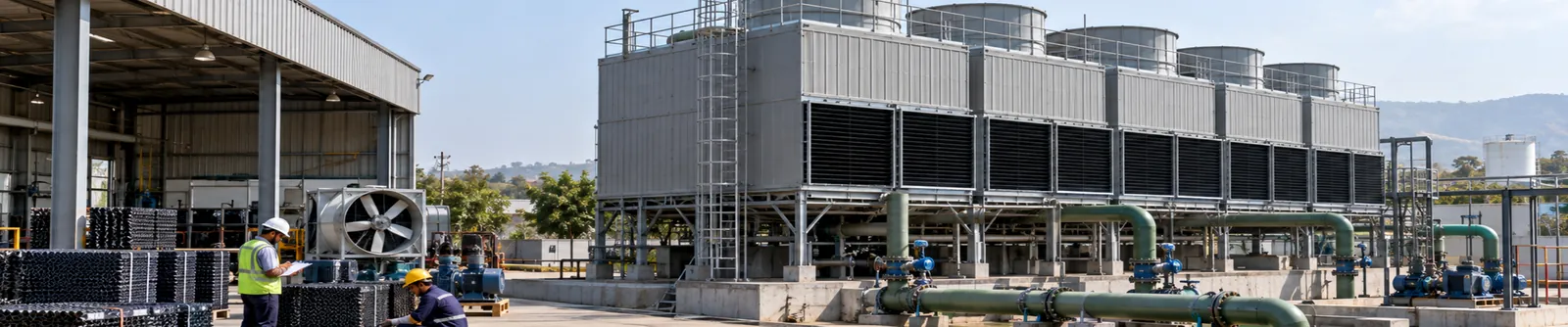
Top FRP Cooling Towers Manufacturers in Coimbatore
SP Cooling Towers Pvt Ltd., as an FRP Cooling Tower Manufacturers in Coimbatore, provides FRP cooling tower solutions designed around the cooling requirements of different industrial applications. The selection of an FRP cooling tower can be considered according to factors such as heat load, water flow, operating conditions, available installation space, and the intended cooling process. This approach allows industries to consider an FRP cooling tower configuration that aligns with their operational requirements.
How Does an FRP Cooling Tower Work?
The concept of an FRP cooling tower is to exchange the heat in the warm circulating water with the air. The tower is heated with water, which is pumped through the tower, and the air exiting the tower allows heat to escape, and the water temperature decreases, and the cool water is recirculated into the process.
Cooling relies on the flow of water and air through the tower, with the flow pattern depending on its design. With the warm water flowing through the tower and interacting with airflow, the heat is transported, and the process of cooled water circulation can be maintained, allowing the necessary use of the means.
-
Hot Water Entry: Warm process water flows into the tower to be cooled.
-
Water Distribution: In the cooling procedure, the water is dispersed to ensure maximum contact with air.
-
Air Movement: The functioning of the tower relies on the use of air to eliminate heat.
-
Heat Transfer: The circulating water loses heat absorbed from the air surrounding it.
-
Cool Water: The cooled water is then used in the process.
Trusted FRP Cooling Tower Suppliers in Coimbatore
Being FRP Cooling Tower Suppliers in Coimbatore, SP Cooling Towers Pvt Ltd. provides FRP cooling tower systems that are applicable to various industrial cooling needs. The choice can be matched with factors like required cooling capacity, flow of water, operating conditions, and available space where it can be installed.
Our supply strategy aims to supply the right FRP cooling tower design based on the application and system needs. This helps industries to think about the right tower layout without compromising the cooling system in the scope of the operation's needs and expected performance.
-
Application-Based Selection: The towers can be chosen based on the application of the cooling.
-
Capacity Requirements: The choice will be based on the necessary cooling load and water circulation.
-
Operating Conditions: Tower choice is able to take into consideration the conditions of operation of the system.
-
System Compatibility: The cooling tower has to be compatible with the current process setup and water recirculation.
-
Installation Space: When selecting a cooling tower design, space for installation is accounted for.
Key Components of an FRP Cooling Tower
FRP cooling tower consists of several components that work together to get water and air circulating within the system and ensure heat transfer occurs. Every element has its own purpose, as some of them are involved in distributing circulating water, directing airflow, and collecting the cooled water to be returned to the process.
These elements are set and chosen according to the design of the tower and its working needs. It is the well-matched components that help the cooling tower to perform as a system, which allows water, airflow, and heat transfer to cooperate in their work.
-
Fan: Pushes the air in the cooling tower to aid in the exchange of heat.
-
Fill Media: Gives the surface contact that is more intimate between water and the moving air.
-
Drift Eliminator: Minimizes the dragging of water droplets with the exiting air circulation.
-
Water Distribution: Circulates the water throughout the cooling space.
-
Fan Cylinder: Directs and directs air around the fan assembly.
Leading FRP Cooling Tower Exporters in Coimbatore
SP Cooling Towers Pvt Ltd. provides the FRP cooling tower to meet the needs of the industries where the tower setup, cooling capacity, and working environment must be suitable for the intended use. The company is among the top FRP Cooling Tower Exporters in Coimbatore is concerned with the provision of the appropriate cooling tower solutions according to the needs presented by the buyers.
The process of export supply includes the knowledge of the necessary specifications and matching the cooling tower with the application, the conditions of installation, and the anticipated cooling load. This strategy aids purchasers in obtaining an FRP cooling tower that meets their process demands and ensures that there is consistency between the ordered system and the tower provided.
-
Requirement Assessment: Cooling specifications are taken into consideration when selecting the design.
-
Configuration: Cooling tower design is done in accordance with the requirements.
-
Capacity: Cooling load should be considered when selecting appropriate equipment.
-
Specifications: The technical specifications should be discussed in case of using the proposed equipment.
-
Supply: FRP cooling towers are delivered based on the requirements of the buyer.
Types of FRP Cooling Towers
FRP cooling towers come in various designs, with each type having a specific airflow, water circulation, and heat-transfer need. The right type will depend on the cooling task, the environment where it will be operated, the space available, and the process that will be undertaken by the use of the tower.
Various FRP tower configurations can thus be adapted to the various industrial purposes instead of adopting one standard configuration. This information is crucial in making a suitable choice of a cooling tower that will suitably meet the requirements in terms of cooling capability as well as compatibility with the environmental conditions at the installation site.
-
Counter Flow: Air goes in the opposite way to the water, which goes down.
-
Forced Draft: Fans force the air necessary for the cooling process.
-
Induced Draft: The fan system pulls air across the tower and water stream.
-
Natural Draft: This is the movement of air in the tower that is not affected by the assistance of mechanical fans.
FRP Cooling Tower Applications
FRP cooling towers are applicable in industrial processes where circulating water is supposed to be cooled so that it is sent back to the system. Their use is based on the process heat load, water circulation demand, and conditions of operation, so the choice of a tower can be significant to preserve the necessary cooling cycle.
They may be applied to the processes that produce heat by continuous equipment or production processes, where water cooling needs to be controlled. The appropriate FRP cooling tower is not a universal design to fit all applications, but rather, it is determined based on the conditions of the process, cooling duty, and system needs.
-
Chemical Processing: Applied in situations when there is a need to remove heat from process water.
-
Manufacturing: Helps control the heat that is produced in the manufacturing industry.
-
Power Plants: They are designed to cool the circulating water in the power plants.
-
HVAC Systems: Make use of heat rejection methods at places with water cooling.
-
Process Cooling: High flows of cooled water to industrial operations that need constant removal of heat.
Advantages of FRP Cooling Towers
FRP cooling towers provide an effective construction choice for industrial cooling systems where environmental conditions and durability matter. Their construction of fibre-reinforced plastic offers them an appropriate structure that is applicable in processes that need a constant flow of water and heat removal.
The benefits of an FRP cooling tower are also based on the choice of configuration according to the operating conditions and cooling demands. With proper specifications, the tower can offer reliable cooling capabilities without compromising its ability to withstand harsh industrial conditions.
-
Corrosion Resistance: FRP construction has resistance to corrosion in appropriate operating conditions.
-
Durability: The material offers a strong framework in industrial cooling systems.
-
Lightweight Construction: FRP is one of the lightweight structural materials compared to many of the conventional structural materials.
-
Minimal Maintenance: The FRP structure needs minimal attention as opposed to materials that are subject to corrosion.
-
Long Service Life: FRP construction, when used and maintained properly, can be in service over a long period.
How to Choose the Right FRP Cooling Tower?
The first thing to do when choosing an FRP cooling tower is to have a clue about the cooling task and operational requirements of the situation. The tower configuration should be determined by the heat load, flow of the circulating water, inlet and outlet temperatures, available space, and required cooling performance of the tower.
The choice they make should also be based on the environment that the tower will be working in and how it will fit into the existing process. Through the combination of these requirements, industries are able to choose an FRP cooling tower that is perfectly suited to their use as opposed to using a standard design.
-
Heat Load: Find out how much heat must be taken away from the circulating water.
-
Water Flow: Take into account the necessary rate of circulation of the cooling system.
-
Temperature: Assess the inlet and outlet water temperatures that are needed.
-
Space: Inspect the space of the tower setup and operation.
-
Application: Select the tower based on the unique industrial cooling need.
FRP Cooling Tower Installation
Installation of the FRP cooling tower starts with the evaluation of the site and the location where the tower should be installed in the cooling system. The space, foundation needs, water supply, air circulation, and accessibility must be looked into to ensure that the tower is placed in a strategic position to be used and maintained.
When the area of installation is ready, the tower is placed and connected to the necessary water circulation and system setup. The proper alignment of the tower and its attachments also helps in the determination of the desired direction of flow of water and air, and then operational checks are done to ensure that the cooling system is in place.
-
Site Assessment: Observe the site along with the surrounding environment before beginning installation.
-
Foundation: Work on making a proper and firm base for the tower.
-
Placement: Place the tower properly as indicated by the layout of the site.
-
Connections: Connect the cooling water to the necessary system pipelines.
-
Commissioning: Check operation and system performance prior to normal use.
FRP Cooling Tower Maintenance
Periodic servicing of an FRP cooling tower can maintain the intended water circulation, airflow, and heat transfer. Periodic inspection of the tower structure and working parts may help to reveal the emerging problems before they impact the cooling process performance or the process itself.
The maintenance requirements are also based on the tower design, conditions of operation and frequency of operation. A check of the water supply system, airflow layout and the availability of parts at appropriate times will ensure consistency in operation and ensure that possible wear or performance problems are countered in time.
-
Water System: Water circulation and distribution: Check that water circulates properly.
-
Fan Assembly: Check the fan and its components for abnormal operation.
-
Fill Media: Check the fill area for blockage or deterioration.
-
Drift Eliminator: Visualize any damage or buildup that can influence airflow.
-
Form: Visually examine the FRP body and areas that are accessible to identify any visible damage.
FRP Cooling Tower Price and Cost Factors
An FRP cooling tower cost varies based on the cooling capacity, water flow requirements, tower configuration, and specifications needed to ensure the intended usage. The total price may thus be adjusted to suit the size and technical specifications of the cooling system instead of having a fixed price per project.
The final cost can also be affected by other factors, such as the installation requirements, system connections, and the components to be used in the tower, etc. Assessment of these needs assists buyers in determining how much the entire cooling solution costs, and the FRP cooling tower will be selected to suit the application and the project.
-
Cooling Capacity: The increased cooling demands may affect the total tower cost.
-
Tower Size: The physical size needed is dependent on the cooling load and the flow of water.
-
Configuration: The type of tower configuration influences the equipment specification.
-
Components: The cooling tower components needed may add to the overall cost.
-
Installation: Site preparation, connection, and installation requirements can impact project expenditure.
FRP Cooling Tower vs. RCC and Steel Cooling Towers
FRP, RCC, and steel cooling towers are not only different in terms of the construction materials but also in terms of their structures and applicability to specific operating conditions. FRP weighs very little and is also corrosion-free in nature. RCC and steel have different structural properties, which can be taken into consideration when the application requirements and the installation requirements differ.
The decision on which of these tower constructions to use should be based on cooling duty, site, maintenance considerations, and the needs of the overall cooling system.
The comparative evaluation of these factors assists in deciding the material and tower construction that would be more applicable in the target industry application.
-
FRP: Lightweight construction that has good resistance to corrosion and the environment.
-
RCC: Construction based on concrete that would be appropriate for construction that demands high-strength construction.
-
Steel: Metal construction that may be used to offer a rigid structure for appropriate cooling purposes.
-
Maintenance: The maintenance needs depend on the building material and environment in which it is operated.
-
Selection: The selection is based on the cooling needs, location needs, and project needs.
Why choose SP Cooling Towers Pvt Ltd. for an FRP cooling tower?
Since we are an Indian based company, we will offer effective and high-quality solutions to the clients in the context of Coimbatore (SIDCO Kurichi, Malumichampatti and Karumathampatti) in such a way that it is consistent, trusted, and completely satisfied with each need. With experience in supplying and manufacturing cooling towers, SP Cooling Towers Pvt Ltd. offers FRP cooling tower solutions that address the various industrial cooling requirements.
To identify the kind of tower solution that will be projected, we begin by hearing about the application, the volume of cooling required, and the purpose of the tower. This allows the buyers to not only acquire an FRP cooling tower that meets their process requirements, but also to be able to get the proper cooling tower products and spares.
-
Experience: Incorporated in 2004, with experience in cooling tower manufacturing and supply.
-
FRP Solutions: Cooling towers are industrial cooling towers.
-
Product Range: Offers cooling towers along with relevant replacement spares.
-
Application Focus: Solutions to different industrial cooling needs.
-
Service: Offers installation, repair, and maintenance services for cooling towers.
Get the Right FRP Cooling Tower for Your Industrial Cooling Requirements.