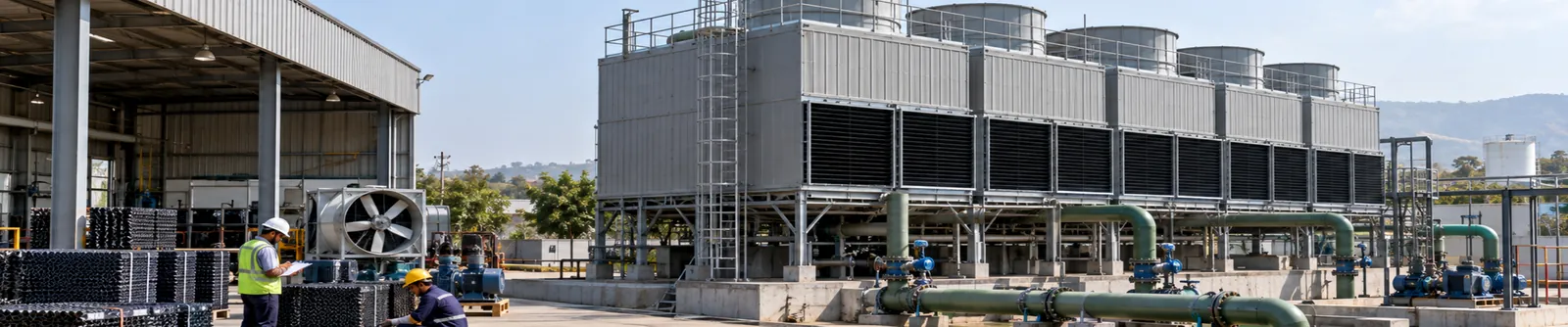
Applications of Timber Cooling Towers
Timber cooling towers remain specified in installations where their particular structural and thermal characteristics suit the application:
-
Power plants — large-capacity condenser cooling in legacy and upgraded installations
-
Steel and heavy manufacturing — process cooling in demanding industrial environments
-
Chemical and petrochemical plants — continuous process cooling requirements
-
Paper and pulp industry — process water cooling at scale
-
District and utility cooling — centralised cooling supply where timber towers are already established
-
Refineries — large-volume process cooling in continuous operation
Timber Species Used in Construction
The choice of timber species has a direct bearing on how well a tower resists rot, insect attack and dimensional movement over its service life:
-
Douglas fir — widely used for its strength-to-weight ratio and reasonable natural decay resistance, common in structural framing
-
Redwood — valued for natural resistance to decay and insects, historically used where re-treatment access is limited
-
Treated pine — economical option that performs well once properly pressure-treated, common in cost-sensitive installations
-
Teak and other hardwoods — used in select applications for superior natural durability, at a higher material cost
Treated Timber vs Untreated Timber: What's the Difference
Whether timber is treated or left untreated determines how long it lasts in a continuously wet, warm environment — exactly the conditions a cooling tower creates:
-
Untreated timber — decays rapidly under constant wetting and drying cycles, since natural resistance alone rarely withstands sustained cooling tower service
-
Pressure-treated timber — preservative is forced deep into the wood fibre under pressure, protecting the timber from the inside rather than just coating the surface
-
Surface-treated timber — preservative applied by brushing or dipping protects only the outer layer, offering weaker long-term protection than pressure treatment
-
Fire-retardant treated timber — combines decay resistance with reduced flammability, specified where fire safety codes require it
-
Cost vs service life trade-off — untreated timber costs less upfront but requires far earlier replacement, usually making pressure-treated timber the lower lifetime cost option
Factors Affecting Cooling Tower Efficiency
Cooling tower performance depends on more than tower size, and overlooking any one factor can leave a correctly sized tower underperforming:
-
Wet bulb temperature — the theoretical performance limit; a tower can never cool below it
-
Approach temperature — the gap between cold water outlet and wet bulb; a smaller approach demands a larger tower
-
Water and air flow rates — must be balanced correctly across the fill for the design range to be achieved
-
Fill and timber condition — decay, warping or fouling on timber grillage disrupts water and air flow patterns and cuts efficiency
-
Ambient humidity and airflow obstruction — nearby structures or recirculating exhaust air raise the effective wet bulb the tower sees
-
Water quality — poor treatment accelerates both fill scaling and timber deterioration, degrading performance over time
Reliable Timber Cooling Tower Suppliers in Vijayawada
As a reliable Timber Cooling Tower Suppliers in Vijayawada, we hold key components and can supply complete towers engineered to your capacity, footprint and site conditions. With supply coordinated across Vijayawada (Autonagar, Kondapalli, Gannavaram and Mallavalli), delivery is planned around your installation schedule rather than routed through a single fixed dispatch point. Buying from a supplier who understands timber construction means your tower is built and treated correctly from the outset, with a maintenance and re-treatment schedule that protects your investment over its full service life.
Why Timber Towers Need Periodic Re-Treatment
Preservative treatment doesn't last the life of the timber indefinitely, and skipping re-treatment is one of the most common reasons a timber tower fails early:
-
Preservative leaching — constant water flow gradually washes preservative out of the timber's outer layers over years of service
-
Surface exposure to sun and air — UV exposure and cyclic wetting/drying break down the treated layer faster than submerged sections
-
Re-treatment schedule — periodic re-application of preservative, typically every few years depending on service conditions, restores protection before decay sets in
-
Inspection before re-treatment — timber should be checked for existing decay or insect damage before re-treating, since treating already-compromised wood doesn't reverse the damage
Trusted Timber Cooling Tower Exporters in Vijayawada
As an established Timber Cooling Tower Exporters in Vijayawada, we supply industrial customers across the Gulf, Southeast Asia, Africa and other export markets. Every tower is engineered for dismantling, packed to protect treated timber components from moisture and handling damage during long transit, and shipped with complete documentation, installation drawings and commissioning support regardless of destination.
Why Choose Us
A few reasons industrial buyers keep choosing us for their timber cooling tower requirement:
-
Correct timber species and treatment for the application — matched to your site conditions and service life expectations
-
Towers engineered to your load — sized against actual heat load and site conditions, not sold off a fixed catalogue
-
Re-treatment and maintenance guidance provided — protecting your investment well beyond commissioning
-
Export-ready documentation and packing — full commissioning support regardless of destination
-
After-sales and maintenance support — spares, service and troubleshooting available after installation
-
Custom and standard capacities both available — no forced compromise between stock size and actual requirement
Need the Right Timber Cooling Tower for Your Application?
Send us your heat load, flow rate and site conditions, and we'll confirm the right tower specification before you order. Call us now!