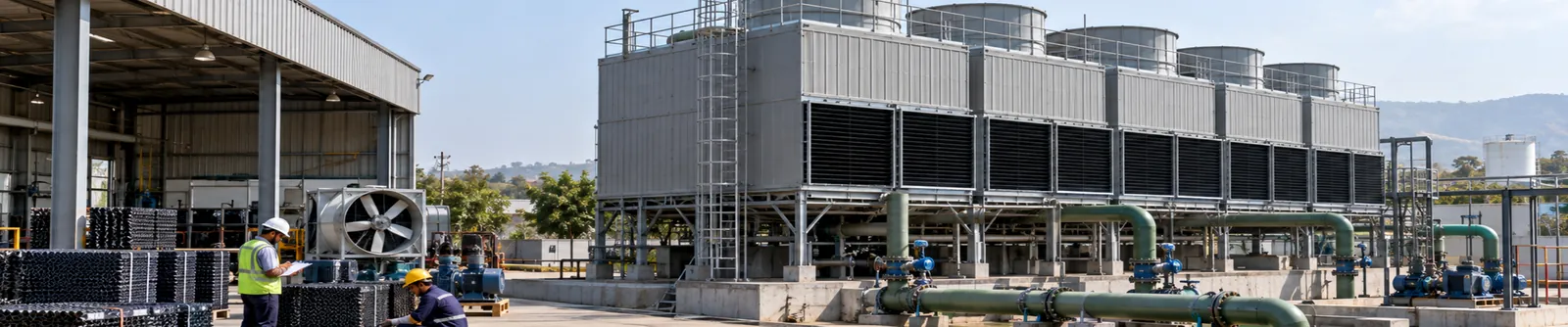
About Induced Draft Cooling Towers
An Induced Draft Cooling Tower is a type of heat rejection system where a fan is installed at the top of the tower to draw air through the cooling tower. It is employed to reduce the temperature of hot circulating water by passing it through air currents, which transfer heat from the water to the air.
In simple words
Hot water → distributed through the tower → fan pulls air upward → heat moves from water to air → cooled water is collected and recirculated.
How an Induced Draft Cooling Tower Works
An induced draft cooling tower is a type of cooling tower that uses an air outlet fan to draw air through the tower. The hot circulating water is sprayed or distributed over the fill media via appropriate nozzles by entering into the tower via the water distribution system.
The fan sucks the air from the environment up through the tower, while the water is flowing downwards across the fill. As water comes in contact with air, a bit of water evaporates, carrying heat from the flowing water to the air. Cool water is collected in the basin and returned to the industrial process.
An induced draft system is a controlled airflow and assists in the removal of warm saturated air from the tower. The selection of the fan, motor, fill media, nozzles, drift eliminators, and water distribution system must be correct to get the desired cooling performance.
Key Features of the FRP Induced Draft Cooling Tower
The optimum operating efficiency and reliability of key features of FRP induced draft cooling tower are described below.
A well-designed FRP Induced Draught Cooling Tower can offer a number of features appropriate to the harsh industrial environment:
-
Corrosion-resistant FRP construction
-
Mechanically induced airflow
-
Efficient air-water contact
-
Efficient evaporation of heat transfer
-
Controlled discharge of warm air
-
Lightweight and rugged construction
-
Customizable cooling capacity
-
Efficient water distribution
-
Selection of fan and motor for each application
-
Capable of long continuous industrial use
-
Easy access to regular maintenance parts
Technical Specifications of Induced Draft Cooling Tower
The specifications of an induced draft tower will depend on the cooling requirement and site conditions.
|
Parameter
|
Typical Specification / Consideration
|
|
Tower Type
|
Induced Draft Cooling Tower
|
|
Construction
|
FRP / Fiber Reinforced Plastic
|
|
Air Movement
|
Mechanically induced draft
|
|
Fan Location
|
Air outlet / top area
|
|
Cooling Principle
|
Evaporative heat rejection
|
|
Water Distribution
|
Spray nozzles / distribution system
|
|
Fill Media
|
Fill PVC, PP or as per application
|
|
Fan Type
|
Axial-flow / application-specific
|
|
Drive
|
Electric motor
|
|
Water Flow Rate
|
Based on the need of the process
|
|
Cooling Capacity
|
Based on heat load
|
|
Water Inlet Temperature
|
Application dependent
|
|
Water Outlet Temperature
|
Application dependent
|
|
Ambient Condition
|
Site wet-bulb temperature
|
|
Drift Control
|
Drift eliminators
|
|
Collection Basin
|
FRP basin
|
|
Application
|
Industrial, process, and HVAC cooling
|
Final specifications should be determined based on the actual process conditions and cooling duty required.
Leading Induced Draft Cooling Tower Suppliers in India
With years of experience in the field of induced draft cooling tower supply, SP Cooling Tower Pvt. Ltd. offers cooling tower solutions to industrial buyers, OEMs, project contractors, process plants, and commercial applications.
As a leading Induced Draft Cooling Tower Suppliers in India Choosing the right tower isn't purely a matter of comparing cooling power. Tower configuration depends on water flow rate, heat load, inlet and outlet water temperature, ambient wet-bulb temperature, water quality, operating hours, and space.
Our methods are based on the matching between the tower design and the actual application. This allows customers to choose the right fan size, fill media, water distribution system, tower size, and other parts for the fan to operate as required.
Main Parts of an Induced Draft Cooling Tower
An FRP Induced Draft Cooling Tower is made up of several parts that collaborate to ensure efficient heat rejection.
FRP Tower Body
The cooling tower's main enclosure is made up of the FRP body. It ensures moisture and corrosion resistance and also has a relatively lightweight construction.
Cooling Tower Fan
The fan is placed at the outlet of the air and sucks the air from outside through the tower. The diameter, speed, and air flow of a fan are chosen based on the cooling requirement.
Fan Motor
The fan is powered by the motor. The selection of the motor is based on the airflow requirement, fan characteristics, operating conditions, and tower configuration.
Fill Media
The more the media are filled, the greater the surface area for air-water contact. This enhances the heat and mass transfer and makes a major contribution to the cooling tower performance.
Water Distribution System
The distribution system distributes the hot water to the fill media. A uniform distribution of water optimizes use of the cooling surface.
Nozzles
Nozzles are used to spray water over the area to be filled. Their arrangement and flow rate should be chosen depending on the amount of water they move.
Drift Eliminators
Drift eliminators decrease the quantity of water droplets that are carried out with the outgoing air, which helps minimize water loss.
Collection Basin
Cooled water is collected in the basin before it is returned to the process / circulation system.
Applications of Induced Draft Cooling Towers
Induced draught cooling towers can be employed in any industry where a continuous cooling process or utility water is required.
|
Industry
|
Typical Application
|
|
Plastic Processing
|
Cooling injection molding machines, hydraulic systems, and process equipment.
|
|
Chemical Industry
|
Cooling reactors, compressors, heat exchangers, and process water
|
|
Textile Industry
|
Cooling of machinery, compressors, and utility systems
|
|
HVAC Systems
|
Condenser-water circuits reject heat.
|
|
Power Generation
|
Cooling of circulating water and heat-generating equipment
|
|
Metal Industry
|
Cooling of furnaces, hydraulic systems, and machines
|
|
Engineering Plants
|
Cooling compressors, machines, and heat exchangers
|
|
Food & Pharmaceutical
|
Water cooling for processes and utility water systems.
|
Advantages of the FRP Induced Draft Cooling Tower
Some of the benefits of using FRP Induced Draft Cooling Towers Include:
The mechanically driven fan ensures controlled air flow and good air-water contact for heat transfer in the tower.
The mixture of fill material, water distribution, and air blowing creates evaporative cooling and efficient heat rejection.
It is moisture and corrosion resistant in many aggressive industrial environments and can withstand continuous water exposure.
The FRP tower structure is comparatively light, which can make transportation and installation easier than many conventional construction materials.
-
Reduced Hot-Air Recirculation
The fan arrangement blows the warm, moisture-laden air upward so there is less chance of the discharged air being drawn back into the tower.
Depending on the water flow, heat load, target temperature, and installation situation, the tower can be configured in different ways.
What Affects the Price of an Induced Draft Cooling Tower?
Several factors can determine the cost of an induced draft cooling tower. The cooling tower price is not only related to the tower dimensions but also to the complete technical configuration of the cooling tower.
Important factors include:
-
Required cooling capacity
-
Circulating-water flow rate
-
Heat load
-
Hot-water inlet temperature
-
Minimum discharge water temperature
-
Ambient wet-bulb temperature
-
Tower dimensions
-
Fan diameter and airflow
-
Motor power
-
Fill media
-
Nozzle configuration
-
Water distribution system
-
Drift eliminators
-
FRP material specifications
-
Customization requirements
-
Packaging and transportation
To obtain an accurate quote, buyers should provide the water flow rate, heat load, operating temperatures, ambient temperatures, and installation requirements.
How to Choose the Right Induced Draft Cooling Tower
It is necessary to determine the actual cooling duty prior to buying an FRP Induced Draught Cooling Tower.
-
Identify Heat Load: Calculate the heat to be removed.
-
Set Up Water Flow: Calculate the water flow rate for circulating water.
-
Set Operating Temperatures: Set hot water inlet and required cold water outlet temperatures.
-
Check Ambient Conditions: Consider the site's wet-bulb temperature when determining expected cooling performance.
-
Evaluate Water Quality: Scaling, suspended solids, biological growth and chemical composition can impact operation and maintenance.
-
Assess Installation Space: Determine installation space, height, and access for air and maintenance.
-
Fan and Motor: The capacity of the fan and motor needs to match the cooling requirement.
Maintenance of Induced Draft Cooling Towers
Regular maintenance of the cooling system ensures its efficiency and helps avoid sudden breakdowns. The fan and motor should be inspected for unusual vibration, noise, misalignment, and mechanical damage, and fans should be checked for defects and imbalance.
Fill media should be checked periodically for scaling, fouling, blockage, and biological growth. Nozzles and the water distribution system should be inspected for clogging or uneven distribution.
The basin must be cleaned to remove sediments and debris, and water treatment parameters should be monitored to control scaling, corrosion, and microbial growth.
Why Choose SP Cooling Tower Pvt. Ltd.
SP Cooling Tower Pvt. Ltd. offers an FRP Induced Draft Cooling Tower solution built around actual industrial operating requirements.
-
Application-Based Selection: Tower configuration based on water flow, heat load, temperatures, ambient conditions, and installation space.
-
FRP Construction: A corrosion-resistant, lightweight structure suited to water-exposed environments.
-
Controlled Airflow: Induced draft fan arrangements provide reliable mechanical flow through the tower.
-
Tailored Configurations: Tower size and key features chosen based on project needs.
-
Multiple Applications: Process industries, HVAC systems, chemical, plastic, textile, power, metal, and engineering applications.
-
Component-Based Design: Fans, motors, fill media, nozzles, drift eliminators, and distribution systems selected to match operating requirements.
-
Technical Guidance: Support for buyers in identifying essential parameters before finalizing the tower specification.
-
Domestic & Export Supply: Cooling tower systems supplied to industrial buyers, OEMs, contractors, and export project applications.
Reliable Induced Draft Cooling Tower Exporters in India
SP Cooling Tower Pvt. Ltd. is a trustworthy Induced Draft Cooling Tower Exporters in India that provides cooling tower solutions to all its industrial customers, OEMs, project contractors, and international customers. We offer FRP-induced draft cooling tower solutions based on the application needs, including cooling capacity, water flow rate, heat load, operating water temperature, ambient temperature, and installation space.
We know that export projects can have different operating environments and technical specifications, as well as packaging requirements, documentation, and installation conditions. Thus, every FRP-induced draught cooling tower can be designed to suit the project requirements of the customer instead of a standard design.
Get the Right Induced Draft Cooling Tower for Your Application
Need a trusted induced draft cooling tower manufacturer, supplier, or exporter in India? SP Cooling Tower Pvt. Ltd. offers FRP Induced Draft Cooling Tower and FRP Induced Draught Cooling Tower solutions tailored to your process needs.
Share your water usage, design inlet and outlet water temperatures, ambient temperature, and installation specifications with our team, and we will help you determine the right tower configuration, technical specifications, and quotation for your application