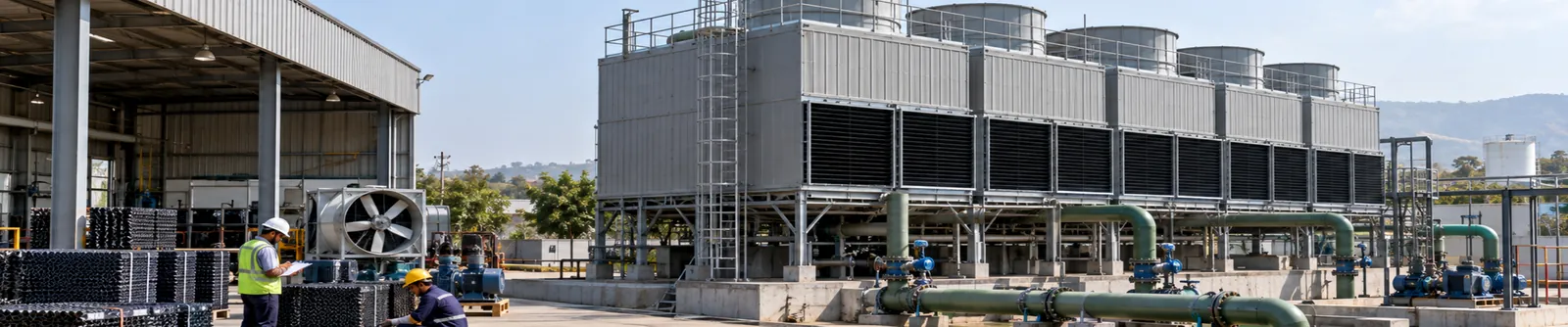
What is a FRP Cooling Tower?
The FRP Cooling Tower is a heat-rejection system in which the main material is Fiber Reinforced Plastic (FRP). It is used to lower the temperature of hot water that is moving around by putting hot water near the air, so the heat goes from hot water to the air.
In simple words
Hot water → distributed through the tower → comes in contact with air → heat is removed → cooled water is collected and recirculated.
How an FRP Cooling Tower Works!
An FRP cooling tower draws hot circulating water into contact with moving air. The water is distributed over the fill material while air flows through the tower. A portion of this water evaporates into the air, carrying heat away with it. The remaining cooled water returns to the basin for reuse in the industrial process—allowing continuous cooling of circulating water and keeping process temperatures within the operating range.
The performance and reliability of an industrial FRP cooling tower depend directly on its design. One of the most significant factors affecting the life of a cooling tower is its construction material—FRP withstands moisture and corrosive operating environments, making it especially suitable for cooling applications. FRP construction also gives a lighter structure that is easier to handle during transport and installation compared with conventional materials.
Key Features of FRP Cooling Towers
These are some of the common key features of FRP cooling towers:
-
Corrosion-resistant FRP construction
-
Light, sturdy frame construction
-
Efficient water-air contact
-
Effective heat-transfer performance
-
Low-maintenance construction, suitable for continuous industrial use
-
Customizable capacity and dimensions
-
Efficient water distribution
-
Easily adaptable fan configurations
-
Suited to a wide range of industrial applications
Types of FRP Cooling Towers
These are some of the types of FRP Cooling Towers:
-
Induced Draft Cooling Tower: Operates a fan on the air outlet to blow the air through the tower and expel warm air. It offers controlled air flow for efficient cooling for industry.
-
Forced Draft Cooling Tower: Blows air through the tower with a fan at the air inlet. It can be used for applications where the airflow setup and installation layout necessitate an inlet fan.
-
Cross Flow Cooling Tower: Allows air to flow horizontally across the falling water through the fill media. It can be designed to allow for easy access for inspection and maintenance.
-
Counterflow Cooling Tower: The fill media moves up, and the water moves down. The opposing air flow and water flow allow for good heat transfer.
-
Round Cooling Tower: The FRP is round and is often used to achieve a compact, symmetrical cooling tower arrangement. It can be designed with various cooling capacities and the water flow.
-
Square Cooling Tower: Uses a square or rectangular base that may be appropriate for an area with a known installation space. It has a customizable capacity and dimension for process needs.
Trusted FRP Cooling Tower Suppliers in India
As trusted FRP Cooling Tower Suppliers in India, we offer cooling tower solutions for industries that require reliable process-water cooling. Beyond the standard tower range, we help customers determine the tower configuration best suited to their specific operating conditions.
Several technical parameters need to be considered before choosing an FRP cooling tower supplier: water flow rate, hot-water inlet temperature, required cold-water outlet temperature, heat load, site wet-bulb temperature, water quality, installation space, and expected operating hours. These factors guide decisions on tower size, fan layout, fill material, and overall design.
Various Parts of FRP Cooling Tower
The FRP cooling tower is composed of several parts, each contributing to its overall cooling efficiency.
|
Component
|
Function
|
|
FRP Tower Body
|
The main structure that encloses and protects the internal cooling components. FRP resists moisture and corrosion while keeping the overall structure lightweight.
|
|
Fill Media
|
Increases the surface area of contact between water and air, enhancing heat and mass transfer within the tower.
|
|
Water Distribution System
|
Ensures even delivery of hot water across the fill area, making full use of the available cooling surface.
|
|
Cooling Tower Fan
|
Circulates air through the tower to support evaporation and heat transfer. Fan size and speed are selected based on cooling load and required air volume.
|
|
Cooling Tower Nozzles
|
Spread water evenly over the fill media. Correct nozzle selection and placement maintain consistent water distribution.
|
|
Drift Eliminators
|
Reduce the carryover of water droplets in the exhaust air stream, minimizing water loss.
|
Importance of FRP Blade for Cooling Towers
In an FRP tower, the fan assembly is an essential component of an induced-draft or forced-draft cooling system. The FRP blade for cooling towers is engineered to provide the necessary airflow for efficient heat rejection in a humid operating environment.
FRP fan blades offer corrosion resistance, light weight, and durability. Their lower weight also helps reduce mechanical stress on the fan and drive assembly.
Fan performance, however, is not determined by blade material alone—it should be assessed alongside the other design factors covered in this guide. The right fan and blade combination helps maintain consistent airflow through the cooling tower and supports stable, efficient operation.
Trusted FRP Cooling Tower Exporters in India Offering Reliable Cooling Solutions
As reliable FRP Cooling Tower Exporters in India, we serve project contractors, OEMs, industrial buyers, and international customers who require cooling towers for a range of project applications.
Export-oriented cooling towers may call for different sizes, specifications, packaging, documentation, and project configurations depending on the buyer's destination, local environmental conditions, and installation requirements. Cooling tower specifications should therefore always be determined by the customer's actual process requirements rather than a fixed standard specification.
Applications of FRP Cooling Towers
Many industries require continual cooling of circulating water, and FRP cooling towers are used across a wide range of them.
|
Industry
|
Typical Application
|
|
Chemical Industry
|
Cooling of process water, heat exchangers, reactors, compressors, and other heat-generating equipment.
|
|
Plastic Processing
|
Controlled cooling of hydraulic systems, process equipment, and molds in injection molding and similar processes.
|
|
Textile Industry
|
Cooling water for machinery, compressors, air-conditioning, and other production equipment.
|
|
HVAC Systems
|
Heat rejection from condensers in central air-conditioning and chilled-water systems.
|
|
Power Generation
|
Discharging unwanted heat generated by circulating cooling-water systems in power plants.
|
|
Metal & Engineering Industries
|
Cooling for furnaces, machinery, hydraulic systems and heat exchangers in foundries and metal-processing plants.
|
|
Food & Pharmaceutical Processing
|
Reliable, controlled process-temperature cooling water circulation.
|
Benefits of Choosing an FRP Cooling Tower
These are some of the benefits of the FRP Cooling Tower:
FRP construction resists moisture and most corrosive environments, making it well suited to industrial applications where water exposure would affect typical materials.
The comparatively light weight of FRP makes transportation, handling, and installation easier—particularly useful where structural or access limitations exist at the installation site.
The corrosion resistance of FRP helps reduce maintenance costs linked to deterioration of the tower body. The fan, motor, fill, nozzles, basin, and water-distribution system should still be inspected routinely for reliable operation.
A properly designed, installed, operated, and maintained FRP cooling tower can offer reliable service over long periods of operation.
FRP can be molded into various shapes and sizes, allowing cooling towers to be designed for different capacities and site-specific application needs.
FRP Cooling Tower Price Depends On- Key Factors
The FRP cooling tower price depends not only on tower size but also on the technical configuration and cooling requirement.
Key factors that can affect cost include:
-
Cooling capacity
-
Water circulation rate
-
Hot and cold water temperatures
-
Heat load
-
Tower dimensions
-
Fan size and motor power
-
Fill media
-
Water distribution system
-
Nozzle configuration
-
Drift eliminators
-
FRP material specifications
-
Additional parts and extras
-
Customization requirements
-
Packaging and transportation needs
For example, a small cooling tower for a modest process-water flow will differ in specification and cost from a high-capacity cooling tower built for a large manufacturing plant.
Buyers should avoid comparing cooling towers on initial purchase price alone—energy efficiency, maintenance needs, component quality, expected service life, and application suitability all factor into the tower's overall value. Sharing accurate data such as water flow rate, inlet water temperature, required outlet water temperature, heat load, ambient conditions, and application and installation constraints helps in preparing an accurate quotation.
How to Select the Right FRP Cooling Tower?
The first step in selecting the proper cooling tower is to calculate the actual cooling duty required.
-
Calculate the Heat Load—determine the amount of heat that needs to be removed from the process; this is one of the main considerations for sizing cooling tower capacity.
-
Determine the Water Flow Rate—the circulating-water flow rate is a key factor in determining tower size and water-distribution capacity.
-
Define Operating Temperatures—assess the hot-water inlet temperature and the desired cold-water outlet temperature, both critical to cooling performance.
-
Consider Ambient Conditions—wet-bulb temperature plays a significant role in tower selection and should be factored into the decision.
-
Evaluate Water Quality—scaling, suspended solids, biological growth, and chemical composition can affect fill selection, maintenance, and water-treatment needs.
-
Check Available Space—the tower must fit the installation space while leaving enough room for operation, inspection, and maintenance.
-
Consider Maintenance Requirements—components should be accessible for inspection and replacement to keep downtime to a minimum.
Maintenance of FRP Cooling Towers
Regular maintenance keeps a cooling tower working at its best. The fan and motor should be examined for abnormal vibration, noise, and mechanical wear. The water distribution system and nozzles should be checked for blockages or flow issues, and the fill media should be inspected periodically for scaling, fouling, or biological growth.
The basin needs regular cleaning to prevent sediment accumulation, and water-treatment parameters should be monitored to avoid scale formation, corrosion, and microbial growth. Routine maintenance helps sustain cooling efficiency and flags potential component issues before they cause unplanned downtime.
Why Opt for SP Cooling Tower Pvt. Ltd.?
SP Cooling Tower Pvt. Ltd. specializes in FRP Cooling Tower Services, tailored to meet these real-world needs.
-
Application Based Selection: Based on the requirement of the application, the appropriate configuration of the tower will be selected, taking into account water flow requirements, heat load, inlet and outlet temperature, ambient temperature, and space available for installation.
-
FRP Construction: FRP offers corrosion protection and lightweight construction and can be used in humid industrial environments.
-
Multiple Tower Configurations: Based on application, customers can opt for induced draft, forced draft, crossflow, counterflow, round, or square cooling tower configurations.
-
Industrial Applications: Cooling towers that we supply can be used in process, HVAC, chemical, plastic processing, textile, power generation, and other industrial applications.
-
Component Based Design: The selection of the key components like fill media, fans, motors, nozzles, water distribution system, and drift eliminators can be done based on the operating requirements.
-
Dimensional and configuration options: Cooling tower sizes and configurations can be tailored to the water flow, heat load, space, and process.
-
Technical Guidance: We assist buyers in the selection of key parameters prior to finalizing their cooling tower specification.
-
Industrial and Export Supply: We supply industrial buyers, project contractors, OEMs, and customers who are looking for cooling tower solutions for domestic and export applications.
Get the Right FRP Cooling Tower for Your Application
Search for the best FRP cooling tower manufacturer, supplier, or exporter from India. Based on the process requirement, water flow, heat load, operating temperatures, and installation conditions, SP Cooling Tower Pvt. Ltd. can help you choose and decide the appropriate configuration of your cooling tower.
Share your cooling needs, and we will discuss with you the appropriate FRP cooling tower configuration, technical details, and our quotation for your application.