It was a sunny monday morning when Rajesh, the maintenance manager in a manufacturing plant, got a call from the production department.
"The machines are overheating," reported the supervisor. "Can you get the cooling tower checked?"
Rajesh stepped out of the building to examine the tower. Water was coming in, the fan was on and there was nothing obviously broken. However, the water flowing from the tower was warmer than normal. Production was scary, the plant manager was eager for answers and Rajesh had just a few hours to get to the bottom of the problem.
This is common in many factories. For all appearances this industrial cooling tower may be operating as it should but there may be minor issues occurring within that are silently diminishing the cooling tower's capabilities. Fortunately, many of the causes for common cooling tower problems are easy to identify and correct.
In our blog we will tell you what are the most usual industrial cooling tower problems, the reasons they occur and the solutions.
A cooling tower helps get rid of excess heat from machinery and equipment in a manufacturing plant. An evaporative cooling tower is similar to a person sweating: as the water evaporates it takes away heat.
Hot water is brought into the tower and spread out over different surfaces known as cooling tower fill media. Airflow through the tower causes a fraction of the water to evaporate. The cooled water then flows through the water cooling system.
The cooling tower working principle – water, air, and evaporation which transfer heat, in a variety of industrial cooling systems. A tower is a single element of an industrial cooling system that could be integrated into a larger cooling system including pumps, process vessels and piping.
As a result of the constant interaction between water and air, the cooling tower maintenance can be adversely affected by dirt, scale, algae, corrosion and normal wearing of mechanical parts. Frequent cooling tower maintenance safeguards the extended chiller system.
What’s Going On?
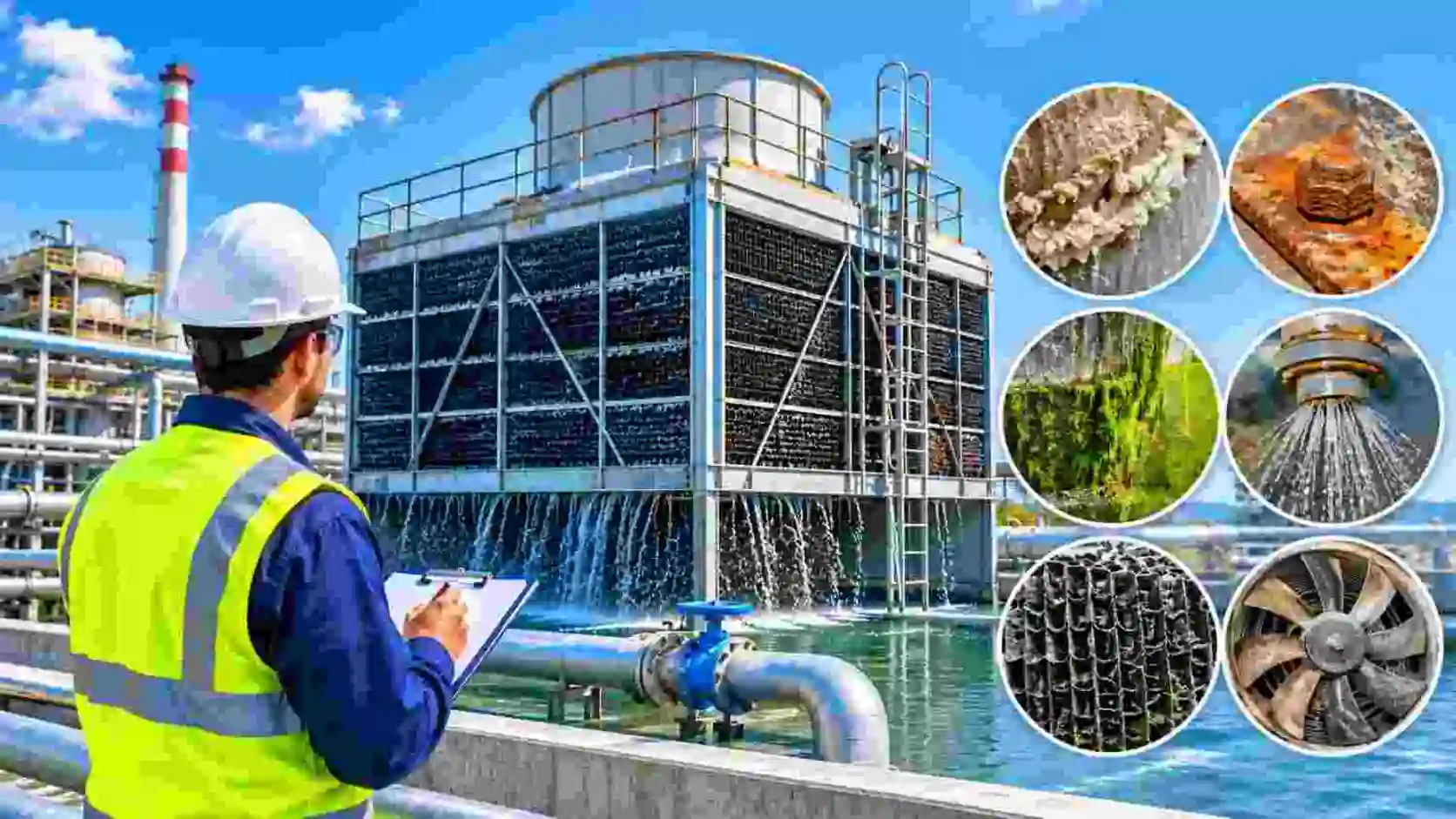
Water has minerals dissolved in it such as calcium and magnesium. When the water is evaporated the minerals are left behind in a concentrated form and can create hard deposits known as scale. Scale will build up on fill media, piping, nozzles, basin and on heat exchanger surfaces.
Why Is It a Problem?
Scale prevents heat transfer by insulating surfaces. Cooling tower efficiency drops and the water stays warmer which can also lead to the equipment not working or consuming more energy. Deposits can also have an impact on an industrial heat exchanger.
Solving It
What Is Happening?
Bacteria are present in cooling water and if the water chemistry is not properly maintained or monitored, the metal parts can rust or corrode. These parts may be the pipes, fasteners, basin, the cooling tower fan assembly and the motors or other cooling tower parts.
Why Is It a Problem?
Corrosion can lead to leaks, leaking parts, water issues, and structural damage. In extreme cases corrosion can lead to a cooling tower repair or result in equipment failure.
How to Fix It
Mechanical equipment or water treatment facilities tanks and structures should be inspected routinely.
What Is Happening?
Warm, moist and illuminated water can be a perfect environment to provide conditions for bacteria, algae, slime and other micro-organisms to thrive, forming a deposit called biological fouling or biofilm. You may notice: green algae; slimy, stinky and bad basin water.
What’s The Issue?
Biofilm covers nozzles, fills media, traps dirt and reduces heat transfer. If not properly maintained, the system can also contribute to legionella problems.
How to Solve It
What Is Happening?
Nozzles spray the hot water on the fill media. Dirt, scale, algae and damage can prevent spray patterns and leave dry patches.
Why Is It a Problem?
Uneven distribution causes water and air not to be in contact with each other. This leads to poor cooling in certain areas of the tower which results in leaving warm water as the outlet, causing a decrease in cooling tower efficiency.
How to Solve It
Rajesh examined the nozzles, which were partially clogged, and discovered some algae by the basin. However, he suspected there might be other problems lurking inside the tower.
Beyond the first symptom are more issues plant teams shouldn't settle with the first sign of a problem like Rajesh. Water cooling towers also can have many other performance, water consumption and equipment life concerns. Here are four more:
| Problem | What happens | Why it is a problem |
|---|---|---|
| Fouled or damaged cooling tower fill media | Fill becomes coated with scale, algae, dust, or oil. It may also sag, crack, or collapse. | Less water surface area meets the air, so the tower cannot reject enough heat. |
| Cooling tower fan, motor, and gearbox issues | Fan blades become dirty, unbalanced, or damaged. Belts slip, bearings wear out, and gearboxes develop faults. | Reduced airflow means less evaporation and warmer outgoing water. |
| Drift and water loss | Small water droplets escape with exhaust air. Leaks, overflow, and splash-out may also waste water. | Treated water is wasted, nearby areas may get wet, and cooling tower water treatment becomes harder to control. |
| Water leaving too warm | The cooling tower runs, but the outgoing water remains hotter than required. | Production equipment may overheat, efficiency drops, and downtime risk increases. |
The issues are very similar. As an example, a dirty fill media can lower cooling capacity, while a faulty cooling tower fan can knock it even further. This is why cooling tower maintenance should focus on the entire cooling tower system, not just one component.
In the event of under-performance a tower support should take account of:
SP Cooling Towers as one of the cooling tower manufacturers offers a complete range of FRP, timber & RCC towers, fill media, drift eliminators, nozzles, fans, fan blades, motors, gearboxes, flow-control valves, SS grids and more.
Current installations include cleaning, parts replacement, retrofits, renewals of thermal-packs, overhaul of rotating equipment, shell repairs, module reconstruction. Support is available for new towers, replacement equipment, upgrades, fan/gearbox support, repairs. Selecting the right cooling equipment is based on heat load, water flow, temperature requirements, and site conditions.
SP Cooling Towers offers these cooling tower types:
The type of design is chosen based on application, flow configuration, flow rates required, maintenance, and space.
Cooling towers are a common solution for industrial cooling and are often used in conjunction with an industrial chiller, industrial water chiller or water chiller. Facilities may require an air cooling system, HVAC cooling system or HVAC cooling tower, which is based on the process and building needs. A specialist can evaluate the system setup.
A lot of big failures take time to develop. Well thought out scheduled maintenance procedures can provide signs of an impending failure before they affect production.
Adjust the time based on site conditions, manufacturer guidelines, water quality, and the time of day of use.
Rajesh's problem was not magic, and it was not suddenly failing. It was a combination of deceptions that we'd overlooked for far too long.
In the industrial cooling tower, the common issues include: scaling, corrosion, biological fouling, nozzle clogging, fill media damage, fan problems, drift, and leaks. The answer is not just cooling tower repair – it's cooling tower maintenance, cooling tower water treatment, component replacement, and cooling tower support.
A well-kept cooling tower cools machinery, keeps down-time to a minimum, uses less power, and contributes to a steady production line.
|
Looking for help with choosing, maintaining or upgrading an industrial cooling tower? Contact SP Cooling Towers for advice on cooling tower solutions. |
Reasons can be dirty fill media, nozzles blocked, scale build-up, fan failure, large heat load, no air flow, poor water treatment, damage to fan etc.
A simple check may be made daily or weekly. A more thorough cleaning could be carried out bi-annually, or depending upon site and manufacturer's requirements.
Scale builds up when minerals in the solution are deposited as the water evaporates resulting in thick deposits hardening on the tower walls.
Yes. They can clog nozzles, coat fill media, decrease efficiency, and exacerbate microbiological issues.
Replace fill when severely scaled, sags, is Cracked / crumbling, collapsed, or becomes unrecoverable by cleaning.
Yes. The support for its component and retrofit products comprises fill media, drift eliminators, nozzles, fans, fan blades, motors, gearboxes, valves and other components.
Share the flow rate, hot and cold water temperatures, and site wet-bulb for tower selection and a budgetary estimate.