Cooling towers are not likely to fail at night. They drift, a degree or two of wasted efficiency this month, a fan a little noisier next month, and a fill pack that gets clogged up a little with each successive season. The tower has typically been underperforming for a long time before the plant managers realize that their energy bill is on the rise. We have also visited hundreds of plants at SP Cooling Towers Pvt Ltd, where the equipment appeared good on the surface but was actually costing lakhs of money in wasted power and water each year. This blog dissects the process of identifying thermal performance problems at the first stage, the components that are commonly involved, and when a replacement or retrofit is more cost-effective than the patchwork repairs.
Each cooling tower is built with a target of a desired heat rejection, yet in real-life conditions, conditions usually do not remain the same. Seasonal water quality variations, seasonal ambient wet-bulb temperatures, and mechanical components wear out due to consistent duty cycles. The accumulation of scale on fill media, dirty nozzles, and eroded drift eliminators all erode the ability of the tower to cool water to design temperature.
The outcome is a longer, more energy-consuming tower that nevertheless does not reach its cold-water setpoint. Unaddressed, this trickles into compressor strain, lower process efficiency and increased maintenance costs in related systems.
The majority of performance problems present themselves in the form of minor, easily brushed-off indications, well before a complete meltdown. Early identification saves a lot of time in the future. Watch for:
None of these in isolation are evidence of a significant malfunction, but combine to create a distinct image of a tower that has lost its thermal advantage. An adequate inspection at this level can frequently avoid a costly emergency closure of the line.
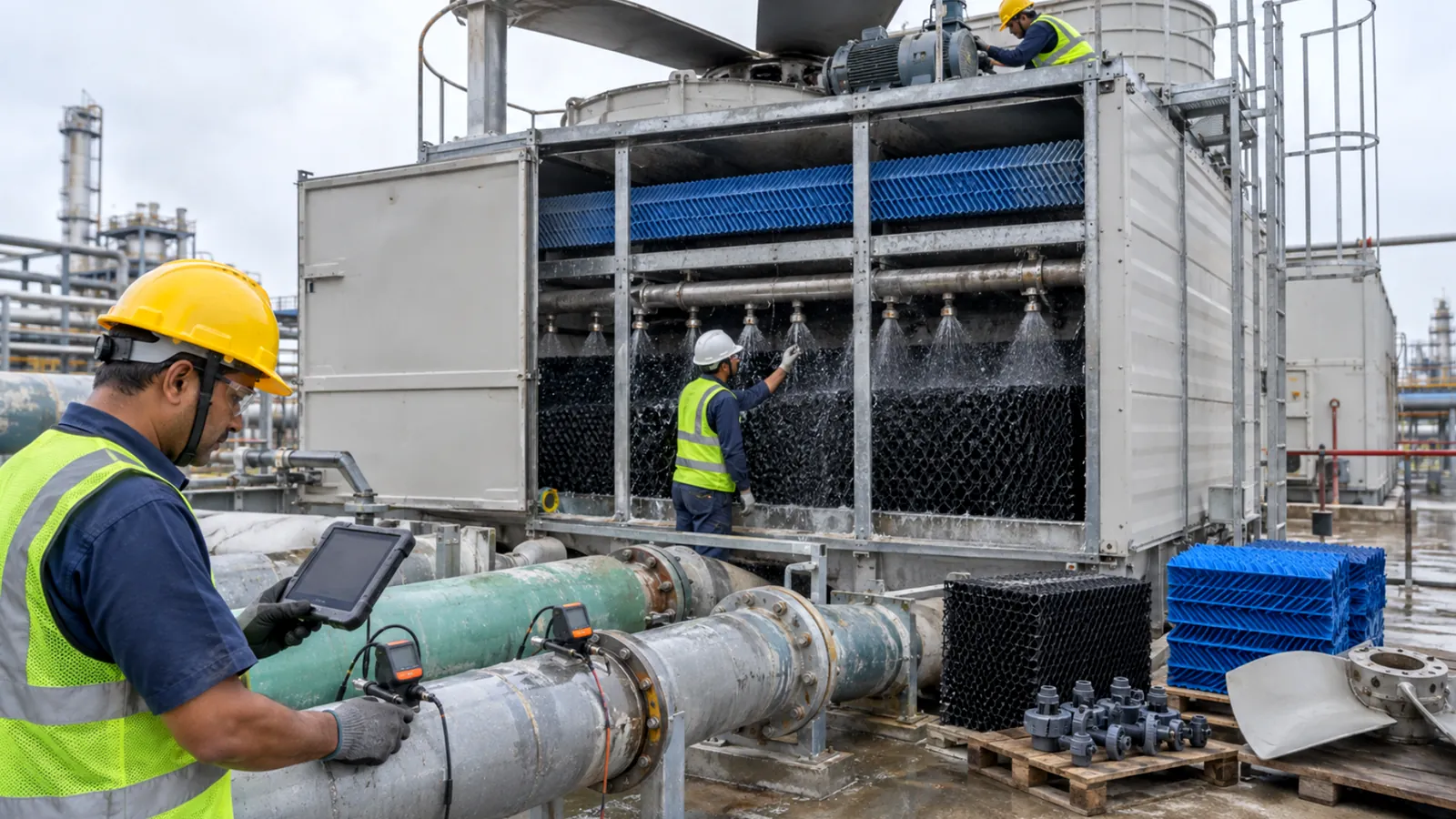
Replacement of parts without diagnosis usually wastes money because the parts that were replaced would not have been the source of the problem. Each of the three systems (water flow, air flow and heat transfer surfaces) is examined as a separate system but related to others in a structured troubleshooting approach. Thermal imaging, flow measurement and analysis of basin water normally give a clue that the problem lies within the mechanical draft system, the fill media or the distribution system.
This is also where several plant teams begin to consider whether they require complete unit replacement or a specific retrofit. And in case you are looking to find a good Cooling Tower Replacement company in India, this is the very point of your diagnosis where such a decision should be made and not when parts are already being changed out without a second thought.
The loss of thermal efficiency due to scale of less than 2mm on fill surfaces can cause up to 20 percent loss of cooling tower thermal efficiency. It is an insulator that layer of that thin material, preventing the heat transfer process which the whole tower relies upon-- a deposit a little itchy to your energy bill.
Not all underperforming towers will require tearing down and reconstruction. The correct decision to make is based on the age of the building, the state of the shell or casing and the amount of internal mechanical system that remains serviceable. The structural frame with failed internals is generally a retrofit project; a corroded or structurally defective unit is best removed and replaced.
Plants in India are turning to specialized Cooling Tower Retrofit Service in India as an alternative to a capital rebuild, increasing the service life of equipment. Retrofitting focuses on those elements that are truly causing the loss in performance namely fill, fans, motors and drift eeliminatorsyet retains the existing structure, saving the project timelines significantly.
A retrofit is not merely a replacement of one used component with another of the same type. It is a chance to update to superior-quality materials and designs, compared to what the tower shipped out with. A successful retrofit normally entails:
This is what most engineers are talking about when they speak of cooling tower revamping—a full upgrade roadmap as opposed to an isolated repair.
The following is a quick guide that many of our clients have found handy when their maintenance teams are attempting to relate a symptom to the probable part at fault, prior to calling in a complete inspection team.
|
Observed Symptom |
Likely Component Involved |
Typical Action |
|
Cold water above design temperature |
Fill media, distribution nozzles |
Clean, descale, or replace fill |
|
High drift/water loss |
Drift eliminators |
Inspect and replace eliminator panels |
|
Rising motor amperage |
Fan blades, bearings, gearbox |
Balance fan, service or replace drive train |
|
Uneven flow across basin |
Distribution deck, nozzles |
Level deck, clear or replace nozzles |
|
Vibration or noise |
Fan assembly, bearings, motor mounts |
Realign, rebalance, or replace fan hub |
|
Algae or biofilm growth |
Fill, basin, water treatment system |
Chemical dosing review, mechanical cleaning |
|
Structural corrosion |
Casing, frame, cold water basin |
FRP recoating or structural retrofit |
Cooling towers installed more than 10 years ago were frequently constructed to older efficiency requirements and their operation in their current form requires an ongoing energy penalty. An old cooling tower upgrade generally pays back in terms of lower power consumption, lower water treatment costs and fewer unplanned outages.
In addition to the direct savings, improved towers are more likely to be more in line with the existing environmental and water-usage regulations, which are becoming more topical as the state pollution controls boards are tightening the discharge and consumption standards. When plants operate many towers in a facility, these upgrades can be staggered per section to evenly spread capital expenditure but still achieve significant efficiency increases in the first upgrade cycle.
One 500-TR cooling tower with fouled fill is enough to use up enough electricity each year to serve about 15-20 typical Indian homes a year. Repeat that in an industrial park with dozens of towers and the argument of timely upgrades becomes quite difficult to overlook.
The successful implementation of a planned cooling tower retrofit is usually carried out in a series of distinct phases, and an awareness of these phases will help plant teams to plan around production without significant offline periods:
Industrial retrofits may be accomplished in a scheduled maintenance period of a few days to two weeks, depending on the tower size and the amount of structural work required. Effective sequencing ensures the disturbance of production is kept at a minimum.
Buying single parts, a new fan here, and a fill pack there will seldom have the same effect as a team that knows how all these parts interact in the entire system. The benefit of a good retrofit can be spoiled by mismatched fill density, improperly sized motors or unbalanced fans.
That is why the plants in various areas are more inclined to deal with a proven Cooling Tower Retrofit Company in India instead of assembling a project by different suppliers. One responsible partner also guarantees the fill, fan, distribution system, and structural components are designed to be synergistic and not as disjointed solutions to a specific symptom and the others remain untouched.
Thermal performance troubleshooting isn't a one-time fix—it's an ongoing discipline. Periodic schedules of inspection, basin water quality tests and periodically adjusting the fans ensure that minor problems do not turn into costly failures. Those towers that are already retrofitted even have the advantage of planned monitoring to identify the next wave of wear before it can impact production.
A professional thermal audit is often the most intelligent initial action that plants can take today, as it weighs the options instead of ordering parts immediately. That audit will give you a definitive answer on whether you are dealing with a mere maintenance repair, a specific retrofit, or a request to completely replace your vehicle—and it takes the guesswork out of a decision that otherwise would prove to be an expensive choice.
Each cooling tower that is performing below expectations is telling a narrative in terms of its temperatures, its ampere draw and its water consumption—the secret is to learn how to read the codes before it becomes a shutdown. You may just need to replace a few of the parts in your plant with modernized versions, or you may need a full system upgrade, but in any event, you want to get your thermal performance that your process requires, without spending money on replacing parts that you do not really need.
SP Cooling Towers Pvt Ltd is a company that engages with industrial and commercial establishments in India in the diagnosis, retrofit and replacement of cooling tower systems based on the measurable performance enhancement. When your tower has been wandering off course in regard to its design features, an adequate audit today can save significant amounts of money as compared to the part order that is in haste tomorrow.
Don’t wait for rising energy costs, excessive water consumption or unexpected downtime to become major problems. SP Cooling Towers Pvt Ltd can help you identify the root cause of poor cooling tower performance and determine whether you need targeted repairs, a complete retrofit, or a full cooling tower replacement.
Get a professional thermal performance audit and make your next upgrade decision based on measurable performance—not guesswork.
Talk to Our Cooling Tower Experts Today—Schedule Your Thermal Audit
Share the flow rate, hot and cold water temperatures, and site wet-bulb for tower selection and a budgetary estimate.