Take out your electricity bill and your water bill. Now add in what you paid your maintenance crew last quarter. Most of that money went into a machine for most power stations.
The initial cost of buying a cross flow cooling tower is simply the cost of buying it. With each rotation of the fan and drain, your cooling tower running cost keeps taking an increase hidden from your eyes. Here's where your money goes.
Four bills arrive monthly and your cooling tower energy consumption is nestled in the fattest one. Fan and pump power is consumed by every ripple in the scale cycle, regardless of load.
Water follows on through evaporation, drift, leaks and blowdown. Treatment, the chemicals that keep scale and slime at bay from fill and basins. Upkeep, general maintenance and cleaning, labour and spares.
There's also a hidden price. For a failed fan or motor brings production to a halt. And low cross flow cooling tower efficiency means the tower heats up – increasing the workload of chillers and process machinery.
Here are five fixes that deliver true cooling tower cost reduction without reducing your cooling duty.
Fan power is generally your largest power draw. The cooling tower fan power increases with dirt on the blades or restricted airflow.
In a cross flow tower, hot water falls through the fill by gravity. That usually gives a lower cross flow cooling tower pumping head than pressurised sprays. But long pipes, tight bends, half-closed valves and oversized pumps still waste cooling tower pump energy. Balance the flow across cells, fit the pump to the real duty, and compare pump amperage with design readings every quarter.
Gravity fed hot water runs down the fill in a cross flow tower which means a typical cross flow cooling tower pumping head is lower than pressurised sprays. It also means long pipes, tight bends, half-closed valves and large pumps still drain cooling tower pump energy. Equalise the flow of water through all cells, size the pump for actual duty, and measure pump amps against design once a quarter.
You can't eliminate evaporation because that's what a tower does. There's no point in eliminating drift and leaks because they're a huge waste of water and worn out eliminators increase cooling tower drift loss and cooling tower water consumption.
When the water evaporates, minerals are left and form scale. So you drain some water out and add some fresh water in. This is called a cooling tower blowdown.
Sound treatment pushes away scale and can save you up to a year of cooling tower water treatment costs.
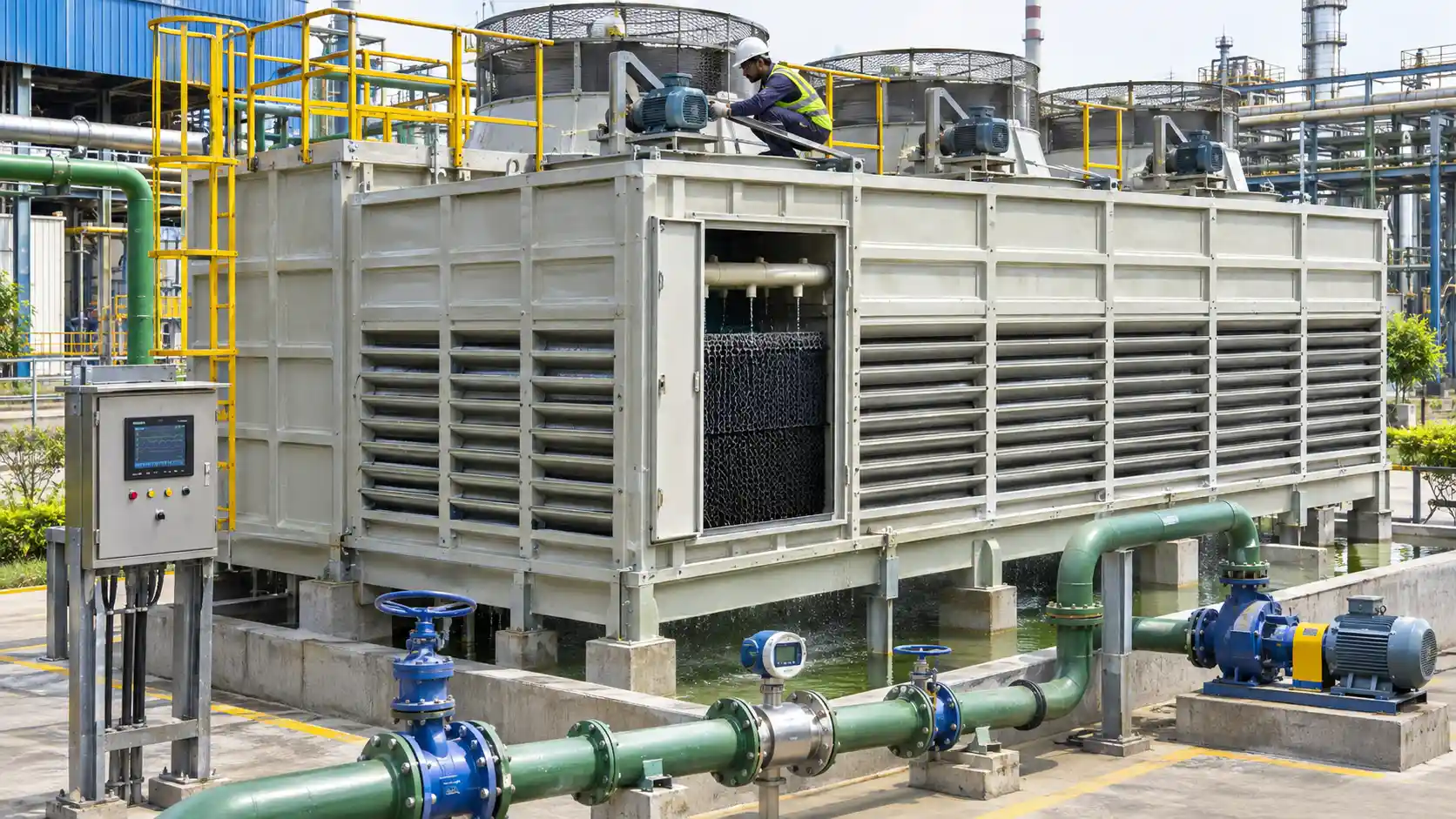
Water passes through fill to be spread into thin films to be cooled by the air. Scale or slime deposits will accumulate in the fill, so cooling tower fill maintenance regularly is important. Inspect all fill packs each season for slime, scale or damage, and look for dry areas where water is not falling evenly.
Clean basins and strainers allow distribution holes to stay clear. Never wipe the scale into the basin without flushing.
When load cracks or crushes order matching cooling tower spare parts. Write down what you find, it'll make next season's check a little quicker.
Here is a simple cooling tower electric cost calculation. Using the fan motor input in kW, multiply that by the number of hours it is running, and your rate per kWh. Take a clamp-meter measurement of the motors input, as the actual can vary from the name plate.
Use these examples. A 15 kW fan will cost you ₹9,60,000 a year with 8,000 hours of use a year at ₹8 a kWh. 10% lower input: saving about ₹96,000 a year.
Improved blade pitch and a cleaner air path, however, could reduce that input. This is how the cooling tower fan energy savings get in front of your finance group.
Walk through this list. Use a basic log to build on your cooling tower operating cost checklist and this becomes straightforward to recognize styles.
| What to Check | What It Tells You |
|---|---|
| Fan motor power and running hours | Your biggest electricity bill |
| Pump amperage and flow balance | Whether the pump is oversized |
| Makeup-water meter reading | How much water you really use |
| Blowdown rate and conductivity | Whether you drain too much or too little |
| Drift eliminators and leaks | Where water is quietly escaping |
| Water quality and scale signs | Whether treatment is working |
| Fill and basin condition | Whether cooling is even |
Good industrial cooling tower maintenance starts with records.
Certain savings backfire. These cooling tower cost saving mistakes occur often, and each time one decreases the cooling tower performance.
SP Cooling Towers have been manufacturing towers since 2004. Searching for cross flow cooling tower manufacturers in India? You will find what you need here:
SP Cooling Towers – one of the authentic cross flow cooling tower suppliers, can identify the real gap, rather than a generic change.
A tower will never be free to run, but it doesn't have to be wasteful. Ease off fan power and pumping energy, reduce water loss, scale and breakdowns, and record your readings once a quarter. Always measure cold-water temperature before throttling back any fan, as a warm tower exhaust heats up your chillers.
Begin with the list and then tell us your obligation and water quality with SP Cooling Towers. We will help you identify how your cross flow cooling tower can do more saving.
|
Require a less expensive to run cross flow cooling tower? Tell SP Cooling Towers your flow rate, the water temperature and the site wet-bulb and the team will help you select the correct tower. Enquire today. |
Share the flow rate, hot and cold water temperatures, and site wet-bulb for tower selection and a budgetary estimate.